


ENGLISH FOR YOUNG LEARNERS (INGLÉS PARA NIÑOS)
Doble Titulación Grado en Maestro Ed. Primaria e Infantil (Zamora)
Curso 2025/2026
1. Datos de la asignatura
(Fecha última modificación: 06-09-25 16:45)- Código
- 105237
- Plan
- 2016
- ECTS
- 6
- Carácter
- Curso
- 3
- Periodicidad
- Segundo Semestre
- Idioma
- ESPAÑOL
- Área
- FILOLOGÍA INGLESA
- Departamento
- Filología Inglesa
- Plataforma Virtual
Datos del profesorado
- Profesor/a
- Patricia Muñoz Andrés
- Grupo/s
- 3
- Centro
- Fac. Ciencias de la Educación
- Departamento
- Filología Inglesa
- Área
- Filología Inglesa
- Despacho
- 214
- Horario de tutorías
- 1er Semestre: L 10:00 am-11:00 am; 3:00 pm-6:00pm
M 1:00 pm-3:00 pm
2do Semestre: J 10:00 am-11:00 am & 1:00 pm-3:00 pm
F 10:00 am-11:00 am & 1:00 pm-3:00 pm
- URL Web
- -
- patryma@usal.es
- Teléfono
- -
2. Recomendaciones previas
This course will be conducted in English, so students are expected to have reached at least a B2 level of English according to the Common European Framework of Reference for Languages (CEFR): http://www.coe.int/T/DG4/Linguistic/CADRE_EN.asp.
Students are recommended to develop their listening, speaking, reading, and writing skills in English to reach at least a B2 level according to the CEFR.
3. Objetivos
By the end of the course the participants will be able to:
- Situate English for Young Learners in multilingual settings
- Introduce language awareness activities
- Analyse, evaluate, use and adapt existing other resources on the market: textbooks, flashcards, posters, stories, songs, plays, rhymes, etc
- Produce home / class-made materials
- Evaluate teaching materials
- Use ICT resources and avoid their potential abuse in the class
- Establish cross-curricular connections and develop the intercultural dimension in language teaching
- Use vocabulary work (pictures, murals, displays, sequences, stories, picture dictations, videos, etc.)
Reflect on and adopt action-research approaches in the teaching practice
- Situate English for Young Learners in multilingual settings
- Introduce language awareness activities
- Analyse, evaluate, use and adapt existing other resources on the market: textbooks, flashcards, posters, stories, songs, plays, rhymes, etc
- Produce home / class-made materials
- Evaluate teaching materials
- Use ICT resources and avoid their potential abuse in the class
- Establish cross-curricular connections and develop the intercultural dimension in language teaching
- Use vocabulary work (pictures, murals, displays, sequences, stories, picture dictations, videos, etc)
- Reflect on and adopt action-research approaches in the teaching practice
- Plan lessons (using a communicative approach) and organize, carry out and assess project work
- Manage the class and get acquainted with the layout, group dynamics, resources, discipline, class routines, etc
- Make an effective use of classroom language (when and how to use L1 in the class, classroom English).
- Diagnose and correct errors (oral vs. written work, immediate vs delayed correction procedures) and use context-bound evaluation techniques.
4. Competencias a adquirir | Resultados de Aprendizaje
Básicas / Generales | Conocimientos.
- DI 16/DP 27 To be able to tackle language learning in multilingual settings.
DP 29 To be able to design and evaluate content from the English curriculum using appropriate teaching resources, and to promote this competence among the students.
DI 17 To recognize and value the importance of verbal and non-verbal communication in the English class.
DP 24 To know the teaching and learning process of the English language.
DI 11 To facilitate English speaking and writing skills.
DP 28 To be able to express oneself orally and in writing in the English language at least at level C1 according to the Common European Framework.
DI 20 To promote interest in the English language at the initial stage.
DP 29 To introduce English language content in the syllabus through appropriate teaching resources and to develop the relevant student competences.
BI 27 To become familiar with various international English as a foreign language teaching situations and strategies
Específicas | Habilidades.
Specific competences that students will be able to develop on completion of this course:
· To acquire linguistic knowledge and competence to work confidently in the Primary classroom.
· To acquire knowledge and competence to develop activities which can promote primary students’ physical and mental engagement.
· To acquire knowledge and competence to observe, analyze, and evaluate the language of the class.
· To acquire knowledge and competence to differentiate types of syllabi.
· To get knowledge and competence to plan lessons for the primary class.
· To get knowledge and competence to control phases and transitions within a lesson plan.
· To do some basic research on specific set targets of the teaching-learning process and develop presentation skills.
· To get knowledge and competence to produce rubrics for classroom observation and discussion.
· To get knowledge and competence to elaborate strategies for self-instruction, critical thinking and professional development.
· To get ICT knowledge and competence to generate teaching resources for the primary classroom
· To get knowledge and competence in management strategies in the primary sector.
· To develop intercultural activities which can lead to open debate but with empathy and respect to others.
· To know the richness and complexity of the English language in this global world.
Transversales | Competencias.
BP 11 To become familiar with the processes of interaction and communication in the classroom.
BP 13 To promote cooperative work and individual effort.
BP 17 To become familiar with innovative teaching experiences in primary education and apply them.
BP 19 To become familiar with basic techniques and methodologies of educational research and be able to design innovative projects through the identification of evaluation criteria.
5. Contenidos
Teoría.
- English in Multilingual & Intercultural Contexts
- Materials & Resource Evaluation
- Storytelling, Songs & Rhymes
- Visual & ICT Resources
- Cross curricular Projects
- Creative Material Design
- Final Portfolio & Teaching Presentation
Práctica.
- Analyze textbooks and multilingual strategies in ECE and Primary
- Compare commercial and class-made materials for both age groups
- Create and adapt stories and chants for Infant and Primary
- Workshop with tools for TEYL
- Create one full cross curricular unit (ECE or Primary)
- Create full sets: story cards, posters, board games, puppets
- Present a materials portfolio and mini teaching demo
6. Metodologías Docentes
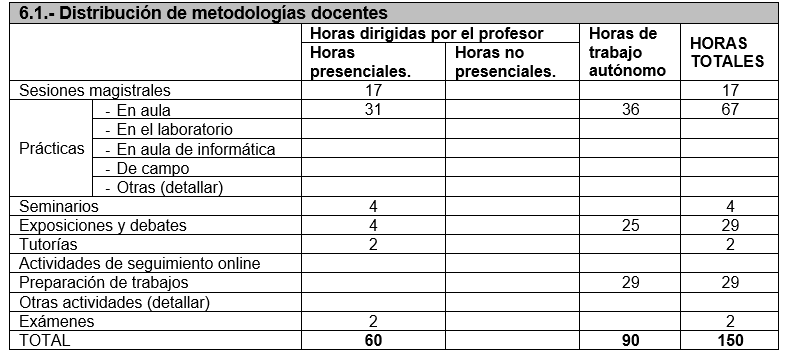
This course is structured around face-to-face theoretical input sessions, followed by hands-on workshops and group-based application tasks. The aim is to provide students with the pedagogical foundations and practical tools needed to select, adapt, and create materials appropriate for English teaching in early learning environments.
Each theoretical session introduces a core topic—ranging from intercultural awareness and visual literacy to the role of storytelling, ICT, and phonics in young learner classrooms. These sessions are designed to build students’ knowledge base and critical awareness of current methodologies and classroom realities.
Ongoing self-study and autonomous learning are essential, and students will be encouraged to build different materials throughout the course. They will also be encouraged to improve their own oral English throughout the course, both through structured assignments and autonomous practice.
7. Distribución de las Metodologías Docentes
8. Recursos
Libros de consulta para el alumno.
Cameron, L. (2003). Teaching languages to young learners. Cambridge University Press.
Corbett, J. (2010). Intercultural language activities. Cambridge University Press.
Ellis, G., Brewster, J., & Girard, D. (2003). The primary English teacher’s guide. Penguin Books.
Garton, S., & Copland, F. (Eds.). (2022). The Routledge handbook of teaching English to young learners. Routledge.
Graham, C. (2006). Creating chants and songs. Oxford University Press.
Harmer, J. (2011). Essential teacher knowledge: Core concepts in English language teaching. Pearson Education.
Hedge, T. (2000). Teaching and learning in the language classroom. Oxford University Press.
Lightbown, P. M., & Spada, N. (2006). How languages are learned (3rd ed.). Oxford University Press.
Linse, C. T. (2005). Practical English language teaching: Young learners. McGraw-Hill.
Madrid, D., & McLaren, N. (Eds.). (2004). TEFL in primary education. Universidad de Granada.
Moon, J. (2005). Children learning English. Macmillan Education.
Nixon, C., & Tomlinson, M. (2010). Primary box. Cambridge University Press.
Pinter, A. (2017). Teaching young language learners (2nd ed.). Oxford University Press.
Read, C. (2007). 500 activities for the primary classroom. Macmillan Education.
Roth, G. (1998). Teaching very young children. Richmond Publishing.
Vale, D., & Feunteun, A. (1995). Teaching children English: A training course for teachers of English to children. Cambridge University Press.
Otras referencias bibliográficas, electrónicas o cualquier otro tipo de recurso.
Council of Europe. (2020). Common European Framework of Reference for Languages: Companion volume with new descriptors. Council of Europe Publishing. https://www.coe.int/en/web/common-european-framework-reference-languages
British Council Learn English Kids: https://learnenglishkids.britishcouncil.org/en/
BBC CBeebies – Stories, songs, games: https://www.bbc.co.uk/cbeebies/
TeachingEnglish – Games and songs for young learners: https://www.teachingenglish.org.uk/teaching-resources/teaching-primary
ESL Kids World – Flashcards, printables, song activities: https://www.eslkidsworld.com/
ESL Phonics World – Free phonics printables: https://www.eslphonicsworld.com/
European Centre for Modern Languages: https://www.ecml.at/en/Resources/ECMLresources
Additional resources will be shared in class.
Ginnis, Paul (2002) The Teacher’s Toolkit. Crown House Publishing.
Graham, Carolyn (2006) Primary Resource Books for Teachers – Creating Chants and Songs. Oxford: OUP.
Harmer, Jeremy (2011). Essential Teacher Knowledge. Pearson.
Hedge, Tricia (2000) Teaching and Learning in the Language Classroom. Oxford: OUP.
House, Susan (1997) An Introduction to Teaching English to Children. London: Richmond.
Lightbown, P. M., and N. Spada (2006) How Languages are Learned. 3rd ed. Oxford: OUP.
Linse, Caroline T. (2005) Practical English Language Teaching: Young Learners. New York: McGraw-Hill ESL/ELT.
Madrid, Daniel, and McLaren, Neil, eds. (2004) TEFL in Primary Education. Granada: Universidad de Granada.
Moon, Jean (2005) Children Learning English. 3rd edition. Macmillan Heinemann.
Nixon, Caroline & Tomlinson, Michael. (2010) i-Primary Box. Cambridge: CUP.
Read, Carol (2007) 500 Activities for the Primary Classroom. Oxford: Macmillan Books for Teachers.
Roth, Genevieve (1998). Teaching very young children. London: Richmond.
Vale, David and Feunteun, Anne (1995) Teaching Children English: A training course for teachers of English to children. Cambridge: CUP.
Other references:
Relevant reference and self-study documents in digital format (word, pdf, ppp, video-clips, audio-tracks) will be available for students in the Studium platform.
On-line resources:
UK Department for Education publications: http://www.education.gov.uk/publications/
Lesson plans: http://www.teachingenglish.org.uk/category/content-type/lesson-plans
BBC games, songs and stories for young children: http://www.bbc.co.uk/cbeebies/
European Centre for Modern Languages: http://archive.ecml.at/
British Council for kids: http://learnenglishkids.britishcouncil.org/en/
Video resources: http://www.teachers.tv
Teaching Knowledge Test: Young Learners:
https://www.teachers.cambridgeesol.org/ts/teachingqualifications/tktyl
http://www.cambridge.org/elt/tkt/
Software for ICT support: http://www.inspiration.com/
9. Evaluación
Criterios de evaluación.
Grading criteria will be distributed as follows:
• Regular attendance and active participation: 10%
• Individual assessments: 30%
• Group presentation: 20%
• Final portfolio: 40%
Sistemas de evaluación.
Written assignments, oral presentations and expositions; assessment of presentation performance.
Recomendaciones para la evaluación.
Class attendance and active participation, regular involvement in the completion of tasks, and intensive consultation of reference reading, other media learning, and teaching materials are highly recommended.
The course is designed for continuous assessment based on participation, collaboration, and applied projects. However, students who cannot attend regularly due to justified reasons may request, during the first week of class, to be evaluated through a final comprehensive exam that covers both theory and applied teaching skills. Students who do not pass the continuous assessment will also be required to take the final exam during the official resit period (segunda convocatoria).