


LABOUR ECONOMICS
GRADO ECONOMÍA
Curso 2026/2027
1. Datos de la asignatura
(Fecha última modificación: 25-06-26 13:37)- Código
- 103755
- Plan
- 237
- ECTS
- 6.00
- Carácter
- OPTATIVA
- Curso
- 4
- Periodicidad
- Segundo Semestre
- Idioma
- ENGLISH
- Área
- FUNDAMENTOS DEL ANÁLISIS ECONÓMICO
- Departamento
- Economía e Historia Económica
- Plataforma Virtual
Datos del profesorado
- Coordinador/a
- Miguel Ángel Malo Ocaña
- Grupo/s
- UNICO
- Centro
- Fac. Economía y Empresa
- Departamento
- Economía e Historia Económica
- Área
- Fundamentos del Análisis Económico
- Despacho
- 218 (FES building)
- Horario de tutorías
- By appointment
- URL Web
- http://diarium.usal.es/malo
- malo@usal.es
- Teléfono
- 923294675
- Colaborador/a Docente
- Ángel Sánchez Daniel
- Grupo/s
- UNICO
- Centro
- Fac. Economía y Empresa
- Departamento
- Economía e Historia Económica
- Área
- Fundamentos del Análisis Económico
- Despacho
- 214 (FES building)
- Horario de tutorías
- By appointment
- URL Web
- -
- angelsd1998@usal.es
- Teléfono
- 923294400 (ext. 6716)
2. Recomendaciones previas
It is not mandatory, but before being enrolled in this course we strongly recommend to follow Macroeconomics III, Microeconomics I, and Microeconomics II.
Language: English
3. Objetivos
LEARNING OUTCOMES
1. A clear written reasoning using the main theoretical concepts.
2. Application of theoretical concepts to real labour markets.
3. Interpretation of the empirical information on the labour market using the relevant theoretical models.
4. Full autonomy to seek and find aggregate empirical information on the main empirical issues related to the labour market (employment, unemployment, wages, labour market institutions, etc.).
4. Competencias a adquirir | Resultados de Aprendizaje
Básicas / Generales | Conocimientos.
Specific and cross skills developed in this course will help students to fulfill the skills requirements described at the module ‘Economic Analysis’.
In detail, we will work the following skills:
Basic/General Skills.
CG1. Knowledge of the economic jargon.
CG2. Development of abstract thinking.
CG3. Understanding the economic problems using models.
Específicas | Habilidades.
CE1. Interpretation of the labour market models (micro and macro models).
CE2. Integration of the knowledge on labour market issues with the rest of courses, especially statistics and econometrics.
CE3. Analyzing the effects of the different labour market policies on the social partners operating in the labour market
Transversales | Competencias.
CT1. Development of scientific criticism and self-criticism
CT2. Writing critical discussions of the statistical information related to the labor market.
CT3. Elaborating essays and written comments using correctly technical jargon.
CT4. Autonomous learning.
CT5. Team work.
5. Contenidos
Teoría.
THEORETICAL CONTENTS:
1. Labour Market Statistics. Basic concepts. Sources: ILO definitions & Administrative data. Stocks. Flows. Wages and labour costs.
2. The Basic Model of the Labour Market. Labour Demand. Labour Supply. Equilibrium under Perfect Competition. Equilibrium under Imperfect Competition.
3. The Labour market and the Macroeconomy. Search models. Collective bargaining and wage determination. Equilibrium unemployment and the Beveridge curve. Insider-outsider models. Macroeconomic implications of collective bargaining. Efficiency wages.
4. Human Capital. Investment in Human Capital. Education and Labour Market Outcomes. General and Specific Training. Cognitive and socio-emotional Skills. Credentialism.
5. Government and the Labour Market. Legal Regulation under Perfect Competition in the Labour Market. Legal Regulation under Imperfect Competition in the Labour Market. Active and passive labour market policies. Policy Evaluation.
6. Wage differences. Wage differences under perfect competition in the labour market: compensating wage differentials. Wage differences under imperfect competition in the labour market: Taste-for-discrimination and statistical discrimination. Empirical findings on discrimination. Alternative pay schemes.
Práctica.
APPLIED ISSUES:
1. Using international labour statistics. Stocks and flows.
2. International databases with labour market information. Micro-data and secondary sources.
3. Main issues related to the impact evaluation of labour market policies.
4. Design of labour market policies.
5. Applied classroom experiments and market simulations alongside other interactive case studies designed to analyze real-world labour market dynamics.
6. Metodologías Docentes
Teaching methodologies by training activities.
Activity 1. Presentations of the teacher about the theoretical concepts and the main tools of the economic analysis of labour markets.
Teaching methodology: The teacher will explain the theoretical concepts promoting critical discussion. Materials to follow theoretical classes will be uploaded to the virtual platform one week before to promote active participation of students. This participation will be part of the learning evidence used in evaluations.
ECTS credits: 0,9 (at the classroom).
Related skills: Skills CG1, CG2, CG3, CE1, CE2 and CE3.
Activity 2. Analysis of cases (real or hypothetical, simplifying real labour market problems).
Teaching methodology: These classes will be highly participative. First, the teacher will briefly present the case (5-10 minutes). Then, the teacher will provide additional material (for example, detailed statistical figures) to the students, organized in small discussion groups. The discussion in small groups will last for around 20 minutes and the conclusions of the discussion will be summarized by a representative of each group. The teacher will promote the debate remarking agreements and disagreements of these summaries. Finally, the students write a short statement with a synthesis of the whole discussion. The teacher will collect these short essays and they will be part of the learning evidence for the course evaluation. To complete the active learning process, the teacher will periodically provide feedback (see activity 5).
ECTS credits: 0,36 (at the classroom).
Related skills: Skills CG1, CE2, CE3, CT1 and CT4.
Activity 3. Short essays and brief presentations on very specific labour market news by small groups.
Teaching methodology: The topics will be selected by the teacher considering those explicitly more interesting for the students. The teacher will collect this information thanks to a short survey launched in the first weeks of the course. The teams will be composed by 2 to 4 students. There will be 3 or 4 short essays during the whole course, and they will include a short presentation in class. The time to develop these short essays will be typically 2 weeks, and one additional week for the presentation. The use of statistical information will be highly valuable for the evaluation. In addition, the ability to seek information and presenting in a comprehensive and easy way will also be highly considered.
As part of the active learning process, the teacher will provide feedback during the presentations and in the follow-up seminars, if needed (see activity 5).
ECTS credits: 1,25 (non-classroom)
Related skills: Skills CE1, CE2, CE3, CT2, CT4 y CT5.
Activity 4. Solving exercises in the classroom
Teaching methodology: The student will work at the classroom applying the learnt concepts to real labour market problems. The class will be organized as in activity 2 (brief teacher’s presentation, discussion in small groups, and pooling conclusions with teacher’s feedback). With this activity, the students will reinforce their teamwork skills thanks to horizontal learning. At the end of the class, the teacher will collect the notes of the discussions, because they will be part of the learning evidence for evaluation.
ECTS credits: 0,24 (at the classroom).
Related skills: Skills CG2, CG3, CE1, CE2, CE3, CT1 y CT3.
Activity 5. Follow-up seminars in small groups.
Teaching methodology: These seminars will provide personalized feedback from the teacher. There will be two seminars per semester. They will be organized in small groups to improve the interactions between the teacher and students. The teacher will also inform to the students that in these seminars they can ask doubts about their learning process, the performance of the different activities, etc., but also about the different topics of the course.
ECTS credits: 0,3 (at the classroom).
Related skills: Skills CG1, CE1, CE2, CE3 y CT4.
Activity 6. Individual study, tests and written exam.
Teaching methodology: While Activities 2 to 5 aim to facilitate student learning, thorough individual study of the handbook and recommended articles is a crucial element for developing a strong understanding of the economic analysis of the labour market. To support gradual learning, there will be one or two tests during the semester. These will contribute to the continuous assessment grade. The written examination serves as a further learning activity and is the final assessment of the course. The examination will consist of questions not previously analysed in the course, but the learning process will equip students with the necessary skills to address them. Activity 4 (problem-solving exercises) will familiarise students with this type of examination. Indeed, some exercises will include questions from past examinations.
ECTS credits: 2,95.
Related skills: Skills CG1, CG2, CG3, CT1, CT2 y CT4
7. Distribución de las Metodologías Docentes
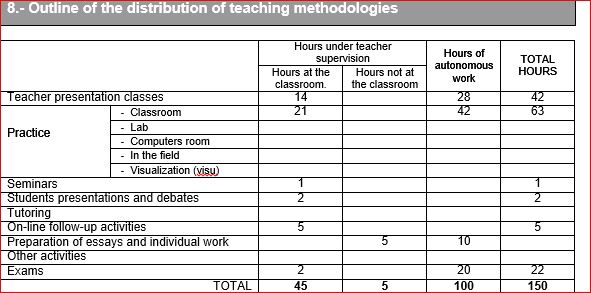
8. Recursos
Libros de consulta para el alumno.
McConnell, C.R., S.L. Brue, D. McPherson (2017): Contemporary Labour Economics, 11th edition, McGraw Hill. [Previous editions are also useful]
Borjas, G. (2016): Labor Economics (International Edition), 7th edition, McGraw Hill. [American editions are also useful]
There will be some supplementary readings on certain topics. These readings will be accessible via the virtual campus and are mandatory.
Otras referencias bibliográficas, electrónicas o cualquier otro tipo de recurso.
Angrist, J. D., & Pischke, J. S. (2009). Mostly harmless econometrics: An empiricist's companion. Princeton University Press.
Boeri, T., Van Ours, J. (2008): The Economics of Imperfect Labor Markets, Princeton University Press.
Booth, A. (1995): The Economics of Trade Unions, Cambridge University Press.
Cahuc, P., Carcillo, S., Zylberberg, A. (2014), Labor Economics, 2nd edition, MIT Press.
Cunningham, S. (2021). Causal inference: The mixtape. Yale University Press.
Garibaldi, P. (2006): Personnel Economics in Imperfect Labor Markets, Oxford University Press.
Layard, R., Nickell, S., & Jackman, R. (2005). Unemployment: Macroeconomic performance and the labour market (2nd ed.). Oxford University Press.
Lindbeck, A. (1993). Unemployment and macroeconomics. The MIT Press.
Pissarides, C. A. (2000). Equilibrium unemployment theory (2nd ed.). The MIT Press.
Sloane, P. J., Latreille, P. L., & O'Leary, N. C. (2013). Modern labour economics. Routledge
Ehrenberg, R. G., & Smith, R. S. (2015). Modern labor economics: Theory and public policy (12th ed.). Pearson.
ILO (2017): Visualizing labour markets: A quick guide to charting labour statistics. Department of statistics. International Labour Organization. Link: https://www.ilo.org/global/statistics-and-databases/publications/WCMS_632187/lang--en/index.htm
ILO (2017): Quick guide on sources and uses of labour statistics. Department of statistics. International Labour Organization. Link: https://www.ilo.org/stat/Publications/WCMS_590092/lang--en/index.htm
Some useful websites:
- Labour Force Survey (LFS) in Spain: Instituto Nacional de Estadistica: https://www.ine.es/
-Labour Force Surveys (LFS) in European Union: Eurostat https://ec.europa.eu/eurostat/data/database
- Other countries: OCDE (OECDStatExtract): https://www.oecd.org/en/data.html
- International Labour Organization (ILO): https://ilostat.ilo.org/es/data/
- U.S. Bureau of Labour Statistics: https://www.bls.gov/data/
- Administrative data in Spain (registered unemployment, registered contracts, social security affiliation, etc.): Statistics from the Ministry of Labour and Social Economy: https://www.mites.gob.es/es/estadisticas/index.htm
9. Evaluación
Criterios de evaluación.
- The students must have a deep command of the main (theoretical and empirical) basic concepts. Evaluated skills: basic skills CG1, CG2 and CG3; specific skills CE1 and CE2; and cross skills CT1 and CT4. Evaluated learning outcome: 3 (interpretation of empirical information using models).
- The students must know how to apply theoretical concepts to real labour markets. Evaluated skills: basic skill CG1; specific skill CE2; and cross skills CT2, CT3, CT4 and CT5. Evaluated learning outcome: 2 (application of theoretical concepts to real labour market) and 4 (Full autonomy to seek and find aggregate empirical information on the main empirical issues related to the labour market).
- The students must understand the economic policy implications of theoretical models and how analyzing the effects of labour market policies. Evaluated skills: basic skill CG3; specific skill CE3; and cross skills CT1 to CT5. Evaluated learning outcome: 2 (application of theoretical concepts to real labour market) and 3 (interpretation of empirical information using models).
- The students must present their reasonings in a clear, coherent and precise manner. Evaluated skills: basic skills CG1 and CG2; specific skill CE1; and cross skills CT2 and CT3. Evaluated learning outcome: 1 (a clear written reasoning using the main theoretical concepts) and 4 (Full autonomy to seek and find aggregate empirical information on the main empirical issues related to the labour market).
Sistemas de evaluación.
The final grade is calculated by combining marks from the following assessment methods:
- Continuous assessment (up to 4 points):
- Individual or small group oral presentations and short essays.
- Tests (no more than 2).
- Written exam (up to 6 points).
The overall grade is the total of the marks from both parts. Students must achieve a total of at least 5 points to pass the course. There is no minimum score required in either part for the marks to be combined. Students who do not reach the overall pass mark of 5 points may take a further written exam. Please note that the continuous assessment mark remains the same for both attempts.
Recomendaciones para la evaluación.
All evaluation trials are designed to check the acquired levels of all skills described in section 6. Therefore, all trials are described considering the link between the relevant skills and the evaluation of learning outcomes.
General considerations
The evaluation is based on the use of different learning evidences. The evaluation of these evidences will include an explicit consideration if there is a positive time trend in the learning outcomes of the student. This trend is considered crucial for a successful learning process. The learning evidences are described following the activities described in the section on teaching methodologies.
Recommendations for the evaluation
There are no contents exclusively taught in practical classes and other topics in the theoretical classes. The continuous assessment and the written exam evaluate different skills but not different parts of the knowledge on labour market issues. As there are practical classes solving exercises of written exams of previous years, attending these classes will allow to the students a successful completion of the written exam.
Recommendation for the second try
The second exam will mirror the conditions of the first. The question style will be consistent with the previous written exam. As before, the final grade will be the sum of the written exam and continuous assessment grades. The continuous assessment grade from the first attempt will be retained. The evaluation criteria will remain consistent.