


CLIL IN THE ENGLISH CLASSROOM (CLIL EN EL AULA DE INGLÉS)
GRADO EN MAESTRO DE EDUCACIÓN INFANTIL
Curso 2026/2027
1. Datos de la asignatura
(Fecha última modificación: 01-09-26 21:07)- Código
- 104904
- Plan
- 251
- ECTS
- 6.00
- Carácter
- OPTATIVA
- Curso
- 4
- Periodicidad
- Primer Semestre
- Idioma
- ENGLISH
- Área
- FILOLOGÍA INGLESA
- Departamento
- Filología Inglesa
- Plataforma Virtual
Datos del profesorado
- Profesor/Profesora
- Tamara Robledo Carranza
- Grupo/s
- 1
- Centro
- Fac. Educación y Turismo
- Departamento
- Filología Inglesa
- Área
- Filología Inglesa
- Despacho
- D16
- Horario de tutorías
- -
- URL Web
- https://produccioncientifica.usal.es/investigadores/107711/detalle
- tamararobledo@usal.es
- Teléfono
- 920353600 ext. 3884
2. Recomendaciones previas
Activities in this course will be conducted in English, so students are expected to have at least a B1 entry level of English according to the Common European Framework for Languages (CEFR): http://www.coe.int/T/DG4/Linguistic/CADRE_EN.asp
Students are recommended to develop their listening, speaking, reading and writing skills in English to reach at least a B2 level according to the CEFR.
3. Objetivos
Get involved in the integrated curriculum within the Spanish state education system and be
fully familiar with
- Know the CLIL approach: origins, rationale and case studies
- Understand the MEC/British-Council bi-lingual project initiated in 1996 for the Infant cycle and
in the Primary Years
- Comprehend the current development of school ¿bilingual programmes¿, its legislation and
implementation
- Benefit from and be familiar with international teaching projects: Comenius, and other linking
programmes across frontiers (school twinning schemes, e-mail correspondence, international exchange
programmes, etc)
- Develop CLIL teaching materials and use strategies for specific subject content in English: P.E., Arts and Crafts, Science, etc
- Plan and assess a CLIL-based syllabus
4. Competencias a adquirir | Resultados de Aprendizaje
Básicas / Generales | Conocimientos.
CG1 La comunicación en la lengua materna, que es la habilidad para expresar e interpretar
conceptos, pensamientos, sentimientos, hechos y opiniones de forma oral y escrita (escuchar,
hablar, leer y escribir), y para interactuar lingüísticamente de una manera adecuada y creativa en
todos los posibles contextos sociales y culturales
CG2 La comunicación en lenguas extranjeras, que implica, además de las mismas competencias básicas
de la comunicación en lengua materna, la mediación y comprensión intercultural.
CG3 La competencia digital, que conlleva un uso seguro y crítico de las tecnologías de la sociedad
de la información (TSI) y, por tanto, el dominio de las tecnologías de la información y la
comunicación (TIC).
CG4 Aprender a aprender, competencia vinculada al aprendizaje, a la capacidad de emprender y
organizar un aprendizaje ya sea individualmente o en grupos, según las necesidades propias del
individuo, así como a ser conscientes de los métodos y determinar las oportunidades disponibles.
Específicas | Habilidades.
De mención:
- Adquirir conocimiento y competencias de orden lingüístico, didáctico y sociocultural de la lengua
inglesa.
- Conocer los principios, desarrollo y formatos de los programas integrados de lengua inglesa y
contenidos curriculares.
- Adquirir competencias para poder participar activamente en los programas bilingües de los centros
escolares.
- Conocer y ser capaz de utilizar, y en su caso de crear, de forma efectiva, recursos para el
aprendizaje y la enseñanza de la lengua inglesa y, entre ellos, las crecientes posibilidades que
ofrecen las TIC.
- Conocer y usar la literatura infantil, las técnicas de dramatización, narración oral, animación,
etc., de manera creativa y efectiva para la enseñanza de la lengua inglesa.
- Conocer, promover, diseñar y animar a la participación en programas de movilidad y colaboración
para alumnos y profesorado con otros países de habla inglesa.
-Ser capaz de investigar sobre el propio proceso de enseñanza y aprendizaje, desarrollando
estrategias de autoaprendizaje, de reflexión crítica y de renovación de la práctica docente.
-Conocer y ser capaz de desenvolverse en un contexto educativo internacional.
-Conocer la riqueza y complejidad de la lengua inglesa en un mundo global y desarrollar una ética
profesional de responsabilidad y un compromiso ciudadano
cimentado en los derechos.
Transversales | Competencias.
BP 11 To become familiar with the processes of interaction and communication in the classroom.
BP 13 To promote cooperative work and individual effort.
BP 17 To become familiar with innovative teaching experiences in primary education and apply them.
BP 19 To become familiar with basic techniques and methodologies of educational research and be able to design innovative projects through the identification of evaluation criteria.
5. Contenidos
Teoría.
- MODULE 1. A window on CLIL: Origins and rationale. What is CLIL? How is it a different model?
What does CLIL claim to do? How many models are there? What kind of problems can we find when
implementing the CLIL approach?
- MODULE 2. Knowledge and principles of CLIL: communication, cognitive and learning skills across
the curriculum. Evaluating, assembling and modifying CLIL materials.
- MODULE 3. Lesson Preparation and Lesson Delivery. Planning a Lesson, Language Demands of Subject
Content, Materials Selection and Adaptation, Classroom Language. Monitoring and evaluating CLIL in action.
- MODULE 4. Assessment in CLIL. Types of assessment. Support strategies for assessment.
Summary of assessment principles.
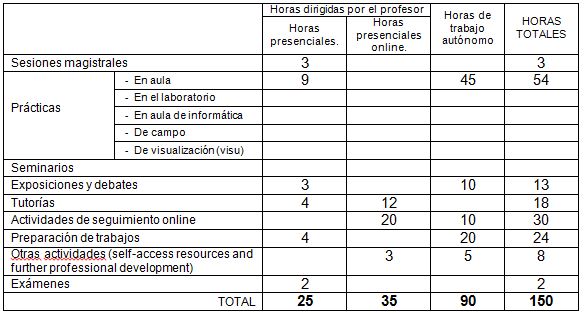
6. Metodologías Docentes
- Lectures
- Individual assignments
- Group projects
Students will be expected to prepare and participate in those activities presented by the teacher
or by other classmates. They will be asked to complete the tasks assigned throughout the course,
such as microteaching sessions, giving short oral presentations, producing individual essays and
producing didactic activities to be presented in the classroom. They will also be expected to put
into practice the instructions commented on in the group tutorials and to develop strategies for
ongoing self-study of a foreign language.
7. Distribución de las Metodologías Docentes
8. Recursos
Libros de consulta para el alumno.
The contents of this subject will be mainly based on the following source:
-
Teaching Knowledge Test. CLIL Module developed by Cambridge ESOL (English for Speakers of Other
Languages)
LIBROS DE CONSULTA PARA EL ALUMNO
- BENTLEY, K. (2010) The TKT Course. CLIL Module. Cambridge University Press.
- CASTAÑEDA PEÑA, M. E. (2023). The roles of language in CLIL. Cambridge University Press.
- COYLE, D., & MEYER, O. (2021). Beyond CLIL: Pluriliteracies teaching for deeper learning.
Cambridge University Press.
- DALTON-PUFFER, C., & HÜTTNER, J. (EDS.). (2024). Building disciplinary literacies in content and
language integrated learning. Routledge.
- HOUSE, S. (2007) Clil: A new model for language teaching in Durán Martínez y Sánchez-Reyes
Peñamaría (Eds.) El componente lingüístico en la didáctica de la lengua inglesa. Ediciones
Universidad de Salamanca.
- MARSH, D. (2000) Using languages to learn and learning to use languages.
Otras referencias bibliográficas, electrónicas o cualquier otro tipo de recurso.
- AMONDARAIN-GARRIDO, M., & RUIZ DE ZAROBE, Y. (2024). Looking into multimodal translanguaging in
CLIL: A case study in the Basque Country. Journal of Multilingual and Multicultural Development.
Advance online publication. https://doi.org/10.1080/01434632.2024.2429419
- BELTRÁN LLAVADOR, F. (2010) “'Content teaching and teaching con'tent through English” in Durán
Martínez y Sánchez-Reyes Peñamaría (Eds.) Linguistic Tools for Teachers of English towards a
bilingual education. Ediciones Universidad de Salamanca.
- BENTLEY, K. (2009) Primary Curriculum Box. Cambridge University Press.
- COYLE, HOOD and MARSH (2010) CLIL. Cambridge University Press.
- DAFOUZ and GERRINI (2009) CLIL across educational levels. London: Richmond.
- DEL POZO MANZANO, E. (2024). La evaluación en AICLE: ¿La asignatura pendiente en la educación
bilingüe? Revista de Educación, 403, 215–240. https://doi.org/10.4438/1988-592X-RE-2024-403-617
- DELLER and PRICE (2007) Teaching Other Subjects Through English. Oxford University Press.
- EUROPEAN COMMISION (2005) CLIL at Schools in Europe. Directorate-General for Education and
Culture.
- GUTIÉRREZ, BELTRÁN AND DURÁN (2010) Un proyecto de aprendizaje integrado de contenidos y lengua
inglesa: Cristobal Colón / A content and language integrated learning project: Christopher
Columbus. Ediciones Universidad de Salamanca.
- HARMER, J. (2007) The Practice of English Language Teaching. Harlow: Pearson
- LÓPEZ-MEDINA, E. F., & CASADO CASADO, J. M. (2024). CLIL, a competence-based
coping strategy against foreign language anxiety in higher education. Discover Psychology, 4(1),
Article 87. https://doi.org/10.1007/s44202-024-00187-6
- MEHISTO, MARSCH and FRIGOLS (2008) Uncovering CLIL. Oxford: MacMillan
- MEYER, O. (2010). Towards quality-CLIL: Successful planning and teaching strategies.
Puls Verlag.
- PITTAS, E., & TOMPKINS, L. (2024). A systematic review of student learning outcomes in CLIL in
LOTE contexts. Frontiers in Education, 9, Article 1447270.
https://doi.org/10.3389/feduc.2024.1447270
- QUEROL-JULIÁN, M. (2024). CLIL teacher online professional development in translanguaging and
trans-semiotizing. Journal of Multilingual and Multicultural Development. Advance online
publication. https://doi.org/10.1080/01434632.2024.2352157
- SCRIVENER, J. (2005) Learning Teaching. (2ⁿᵈ edition) London: Heinemann
ELECTRONIC REFERENCES:
http://www.cambridge.org/elt http://www.eurydice.org
http://www.isabelperez.com/clil.htm
http://www.its-online.com http://www.onestopenglish.com
http://www.teachers.tv
9. Evaluación
Criterios de evaluación.
Desarrollo de supuestos prácticos 20%
Exámenes prácticos 20% Trabajos teóricos y prácticos 20%
Evaluación continua (asistencia y participación activa y sistemática en las diferentes tareas de
forma presencial) 15%
Examen escrito 25%
Sistemas de evaluación.
Exámenes escritos, ejercicios de comprensión auditiva, presentaciones y exposiciones orales, trabajos individuales y otros requisitos.
Recomendaciones para la evaluación.
Se recomienda encarecidamente asistir a clase y participar activamente, implicarse de forma regular en la realización de las tareas y consultar con frecuencia las lecturas de referencia y otros materiales didácticos y de aprendizaje.
Posibilidad de solicitar seguimiento no presencial por alguna de las causas recogidas en el
Reglamento de Evaluación de la Universidad de Salamanca/de la Facultad de Educación y Turismo, en cuyo caso la evaluación se lleva a cabo de la siguiente manera: 50% Examen escrito / 50% Trabajo teórico- práctico.