


CELL SIGNALING IN CANCER
GRADO EN FARMACIA
Curso 2026/2027
1. Datos de la asignatura
(Fecha última modificación: 13-05-26 18:58)- Código
- 100166
- Plan
- 201
- ECTS
- 5.00
- Carácter
- OPTATIVA
- Curso
- 4
- Periodicidad
- Segundo cuatrimestre
- Idioma
- ENGLISH
- Área
- MEDICINA
- Departamento
- Medicina
- Plataforma Virtual
Campus Virtual de la Universidad de Salamanca
Datos del profesorado
- Coordinador/a
- María Carmen Guerrero Arroyo
- Grupo/s
- 1
- Centro
- Fac. Medicina
- Departamento
- Medicina
- Área
- Medicina
- Despacho
- Centro de Investigación del Cáncer (CIC), laboratorio 17
- Horario de tutorías
- Monday to Friday. 12 to 14 h
- URL Web
- https://produccioncientifica.usal.es/investigadores/56798/detalle
- cguerrero@usal.es
- Teléfono
- 923 294 500 Ext. 4817
2. Recomendaciones previas
The students must have basic knowledge in Biochemistry, Molecular Biology, Cell Biology and Genetics. Therefore, they must have passed the courses: “Biology”, imparted in first year and the three “Biochemistry” courses, imparted in first and second years.
3. Objetivos
- To get a general view of the signaling mechanisms developed by cells from pluricellular organisms to communicate themselves and with their environment.
- To know the main signaling transduction pathways at a physiological and pathological level.
- To know the role of the main extracellular molecules, receptors, second messengers and intracellular proteins involved in these processes.
- To be able to describe the main signaling pathways, the components involved, their regulatory mechanisms and the pathological implications of their disfunction with emphasis in the tumoral processes.
- To know the main techniques and models used in cell signaling research.
- To get a basic knowledge about the participation of the main signaling pathways in biological processes, such as proliferation and cell death, differentiation, response to hypoxia and to reactive oxygen species (ROS), adhesion and cell migration, etc. and their relationship with the tumoral disease.
- To learn how to write an experimental report.
- To learn how to discuss a scientific paper.
4. Competencias a adquirir | Resultados de Aprendizaje
Básicas / Generales | Conocimientos.
Específicas | Habilidades.
Transversales | Competencias.
5. Contenidos
Teoría.
Práctica.
6. Metodologías Docentes
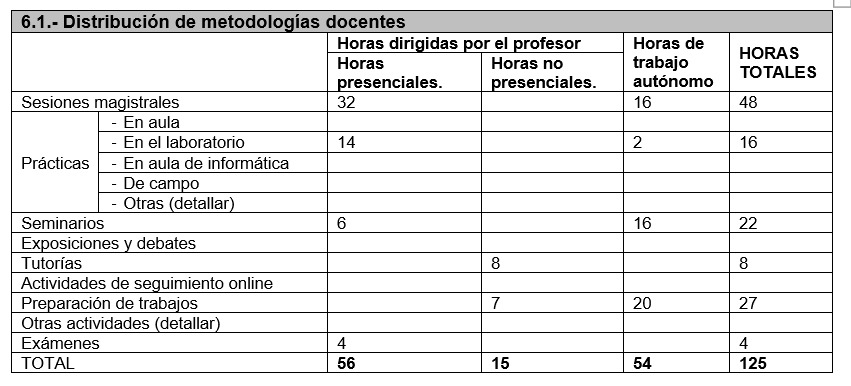
Theoretical contents (18+1 lessons distributed in 32 master classes). Classes will include videos on different aspects related to the course.
Practical contents: 14 hours distributed in 4 days. Practices will be carried out at the Cancer Research Center (CIC), since they require a cell culture facility and access to equipment not available if the “Laboratorios Docentes”.
Seminars: Extension of the lesson contents. The students will give a talk in groups of 2-3 on topics related to the lessons. 2-6 hours depending on the number of students.
7. Distribución de las Metodologías Docentes
8. Recursos
Libros de consulta para el alumno.
Otras referencias bibliográficas, electrónicas o cualquier otro tipo de recurso.
9. Evaluación
Criterios de evaluación.
-
Participation in the master classes and seminars.
-
Performing of laboratory work
-
Interest and comprehension of the lab work
-
Specific questions in the test exam
-
40 Multiple Choice Questions: 60%
-
2 Short Questions: 40%
Sistemas de evaluación.
Described in the above section. The evaluation system is design to assess the acquisition of the skills and learning outcomes described in section 3.
Recomendaciones para la evaluación.
CONSIDERACIONES GENERALES.
Laboratory practicum:
-
Mandatory attendance to laboratory practicum (necessary conditions to pass the matter).
-
Test questions about the practicum in the exam
Seminars
-
Mandatory peformance of announced seminars (necessary conditions to pass the matter).
Continuous evaluation:
-
Participation in theoretical classes and seminars.
Global evaluation proof about the competences to be acquired in the course
It will deal with the contents of the theoretical classes, seminars and, in general, with the competences to achieve. It will last 2-3 hours.
RECOMENDACIONES PARA LA EVALUACIÓN.
Study, consult of questions, handling of bibliographic resources (books and internet), team work.
RECOMENDACIONES PARA LA RECUPERACIÓN.
Practicum:
-
It is not repeated in the next course.
-
There is a possibility to improve the qualification of the practicum in the following courses by performing a new written test about the content of the practicum.
Extraordinary Call: Evaluation
The global qualification will be obtained by calculating the weighted average following these criteria:
1. Continuous evaluation: 5%
-
Participation in the master classes and seminars.
2. Preparation and exposition of seminars: 20%
3. Laboratory practicum: 15%
-
Performing of laboratory work
-
Interest and comprehension of the lab work
-
Specific questions in the test exam
4. Global evaluation test of the competences to be acquired in the course 60%