


INTRODUCTION TO POLITICAL SCIENCE
GRADO EN ANTROPOLOGÍA
Curso 2026/2027
1. Datos de la asignatura
(Fecha última modificación: 19-06-26 14:44)- Código
- 109807
- Plan
- 2020
- ECTS
- 6.00
- Carácter
- BÁSICA
- Curso
- 1
- Periodicidad
- Segundo Semestre
- Idioma
- ESPAÑOL
- Área
- CIENCIA POLÍTICA Y DE LA ADMINISTRACIÓN
- Departamento
- Derecho Público General
- Plataforma Virtual
Campus Virtual de la Universidad de Salamanca
https://studium22.usal.es/my/
Datos del profesorado
- Profesor/a
- Danilo Serani
- Grupo/s
- Grupo 1
- Centro
- Fac. Derecho
- Departamento
- Derecho Público General
- Área
- Ciencia Política y de la Administración
- Despacho
- Planta Jardín
- Horario de tutorías
- Concertar tutoria previo contacto por email
- URL Web
- -
- danilo.serani@usal.es
- Teléfono
- -
2. Recomendaciones previas
No specific prior knowledge is required. However, since there will be texts and articles in English, a minimum level of reading comprehension in the language is required. Classes will be taught in Spanish, and both exams and in-class practical activities will be in Spanish, but some of the practical activities carried out in class will be based on texts in English. Lack of a minimum level of reading comprehension in English is not an excuse for failing to complete the practical activities and answer the questionnaire questions. In addition, given the practical nature of the knowledge acquired, it is essential that students become involved and participate; reading both the recommended texts and newspapers or news and current affairs publications is fundamental.
3. Objetivos
Que el alumno adquiera los conocimientos teóricos básicos para poder comprender y analizar la realidad política.
4. Competencias a adquirir | Resultados de Aprendizaje
Básicas / Generales | Conocimientos.
Basic skills
- CB1. Students should have demonstrated knowledge and understanding in an area of study that builds on general secondary education. This knowledge is usually at a level that, while supported by advanced textbooks, also includes some aspects drawn from the forefront of their field of study.
- CB2. Students should be able to apply their knowledge to their work or vocation in a professional manner, and should have the skills usually demonstrated through the development and defence of arguments and the resolution of problems within their field of study.
- CB3. Students should be able to gather and interpret relevant data, usually within their field of study, in order to make judgements that include reflection on relevant social, scientific or ethical issues.
- CB4. Students should be able to communicate information, ideas, problems and solutions to both specialist and non-specialist audiences.
- CB5. Students should have developed the learning skills needed to undertake further studies with a high degree of autonomy.
General skills
- CG1. Develop full capacity for autonomous learning from a holistic perspective, with a strong theoretical foundation and, at the same time, a goal-oriented approach focused on practical application.
- CG2. Develop coordination and teamwork skills, particularly in interdisciplinary, multicultural and/or international contexts, in order to understand, analyse and evaluate different phenomena in the field of knowledge.
- CG3. Apply knowledge acquired across different areas, together with problem-solving skills, to concrete problems in new or unfamiliar settings within broader interdisciplinary, multicultural and/or international contexts.
- CG4. Understand and apply different research methods, mainly in the Humanities and Social Sciences, in order to analyse human diversity in all its dimensions.
- CG5. Acquire strong critical and ethical awareness of one's own work, including its theories, methods and results.
- CG6. Be able to identify the parameters and factors of cultural diversity in order to interact fully, empathetically and critically with any human group or population, particularly in conflict contexts.
Específicas | Habilidades.
Specific skills
- CE1. Identify the different processes and systems through which human groups adapt culturally to their environment.
- CE2. Describe and define cultural diversity in all its spheres (biological, historical, political, economic, social, etc.) from a holistic and comparative perspective.
- CE3. Recognise the historical processes involved in the transformation of past and present societies.
- CE4. Describe and assess inequality (social, gender-based, disability-related, ethnic-origin-based, etc.) and the conflicts it generates, especially from the perspective of cultural diversity.
- CE5. Recognise and describe, from a cultural perspective, new forms of physical and virtual sociability in a globalised world.
- CE6. Understand, analyse and explain how processes of change affect contemporary society at local and global levels, from a cultural perspective.
5. Contenidos
Teoría.
Object(s) of political and social research
Politics as a science. Approaches and methods of analysis
Political ideologies:
Liberalism, the liberal foundations of contemporary states, the main characteristics of and criticisms of this comprehensive ideology
Populism as a "thin ideology": characteristic elements and criticisms
Cleavage theory, globalization, and the structuring of contemporary party systems in Europe.
Parties and party systems.
Political actors: the far right and its importance in party systems
Political systems
Types of political regimes
Territorial and vertical distribution of power
Electoral systems
Práctica.
6. Metodologías Docentes
This course consists of in-person theoretical and practical sessions, together with non-classroom activities involving students' independent work. The course is designed so that the coordination of both types of activities, equivalent to 150 hours of work (6 ECTS credits), provides in-depth and applied knowledge of the contents under study.
Throughout the course, three hours per week will be devoted to in-person theoretical activities. In addition, one hour per week will be devoted to a compulsory in-person practical class.
Students must attend classes having previously reviewed the assigned literature in advance, and with knowledge of current political reality, both national and international. Each session has an associated practical class with compulsory readings and practical exercises.
7. Distribución de las Metodologías Docentes
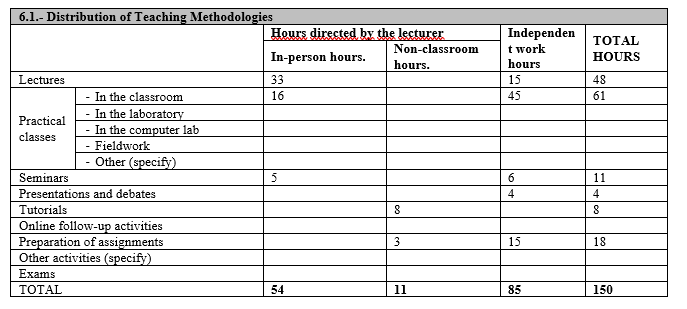
8. Recursos
Libros de consulta para el alumno.
A document with the recommended bibliography for the course will be provided on the first day of class
9. Evaluación
Sistemas de evaluación.
Exam (80%). Students must answer all exam questions at least in their minimum content in order to pass the course. The exam will also assess the contents covered in the readings discussed in class. If a minimum grade of at least 4 out of 10 is not obtained in the final exam, the student must sit the second examination session, regardless of the evaluation obtained in the practical classes.
Practical activities in class and at home (20%). Every week, one hour will be devoted to practical sessions, which students may complete at home within 3 days from their start. Practical activities are compulsory and form an integral part of the final assessment. In order for them to be assessed, students must complete a minimum of 80% of the total practical activities planned throughout the course.
Recomendaciones para la evaluación.
General considerations and recommendations for assessment and resit
Assessment for the course will be carried out continuously throughout the course. The final grade will assess various aspects of students' performance and will consist of the results obtained through a final exam and the completion of practical activities that will begin in class and may be finished at home, as well as attendance and general participation throughout the course
A participatory and proactive attitude in the classroom is recommended, as is attending the reading practice sessions having completed the readings, and carrying out a critical and reasoned analysis of what has been covered in class.
For the resit of the course, the grade for the practical activities will be retained, and the student will only have to retake the multiple-choice exam. However, all students who have failed are advised to contact the lecturer before the exam to discuss the procedures to be followed.