


GENERAL LINGUISTICS
GRADO EN ANTROPOLOGÍA
Curso 2026/2027
1. Datos de la asignatura
(Fecha última modificación: 22-06-26 10:11)- Código
- 109810
- Plan
- 2020
- ECTS
- 6.00
- Carácter
- BÁSICA
- Curso
- 2
- Periodicidad
- Primer Semestre
- Idioma
- ESPAÑOL
- Área
- LINGÜÍSTICA GENERAL
- Departamento
- Lengua Española
- Plataforma Virtual
Datos del profesorado
- Profesor/Profesora
- Elena García Piñuela
- Grupo/s
- Unico
- Centro
- Fac. Filología
- Departamento
- Lengua Española
- Área
- Lingüística General
- Despacho
- -
- Horario de tutorías
- -
- URL Web
- https://produccioncientifica.usal.es/investigadores/1209537/detalle
- elenagarpin@usal.es
- Teléfono
- -
- Profesor/Profesora
- Clara Téllez Pérez
- Grupo/s
- Unico
- Centro
- Fac. Filología
- Departamento
- Lengua Española
- Área
- Lingüística General
- Despacho
- Palacio de Anaya (despacho n.º 006)
- Horario de tutorías
- -
- URL Web
- https://produccioncientifica.usal.es/investigadores/148267/detalle
- clara.tellez@usal.es
- Teléfono
- 923294446 ext.3039
2. Recomendaciones previas
- Preliminary Theoretical Review: Students are advised to familiarize themselves with the fundamental distinctions between human and animal communication systems to establish a solid conceptual baseline.
- Interdisciplinary Preparation: It is recommended to consider the cognitive foundations of language, particularly regarding acquisition and the mental processes of multilingualism, from an anthropological perspective.
- Methodological Readiness: Consistent engagement with theoretical subjects and compulsory readings is essential from the outset to build necessary communicative and analytical competencies
3. Objetivos
OBJECTIVES
- Be able to report on language origin and the origin of language diversity. CG1, CG2, CG6, CE2, CE6, CE7.
- Master the concept of language structure and necessary skills for its analysis. CG1, CG2, CG6, CE2, CE3, CE8.
- Master the principles of language acquisition and learning. CG6, CE2, CE4, CE6, CE7, CE9.
- Master the main principles of language as cognitive function. CG1, CG5, CG6, CE2, CE4, CE6, CE7, CE10.
- Know and understand different linguistic approaches and be able to apply them in the study of language phenomena. CG1, CG2, CG3, CG6, CE1, CE2, CE4, CE5.
- Be able to operate linguistic terminology and develop necessary competence for following scientific texts in English. CG2, CG4, CG5, CG6, CE3.
4. Competencias a adquirir | Resultados de Aprendizaje
Básicas / Generales | Conocimientos.
- Scientific Linguistic Foundations: Advanced understanding of language as a field of study, covering its scientific principles and cutting-edge research applications.
- Systems and Structures: Comprehensive knowledge of human and animal communication, including mastery of linguistic levels from phonetics to pragmatics.
- Cognition and Acquisition: Insights into the origin of language, its mental and neurological processing, and the mechanisms of multilingual development.
- Sociocultural Research: Proficiency in using Humanities research methods to analyze sociolinguistic variation and human diversity in multicultural contexts.
Específicas | Habilidades.
- Analytical and Research Mastery: Ability to interpret complex data and apply diverse research methods from the Humanities and Social Sciences to study human diversity.
- Practical Problem-Solving: Capacity to apply advanced, cutting-edge knowledge to resolve specific problems in professional, interdisciplinary, and multicultural settings.
- Critical Communication: Proficiency in conveying specialized ideas and solutions clearly to both expert and lay audiences, supported by ethical and critical reasoning.
- Autonomous Learning: Development of strong learning abilities to independently manage future studies and professional growth through holistic, theoretically-based training.
Transversales | Competencias.
o CB1. Acquire knowledge and understand concepts related to the field of study building on advanced textbooks on the subject. Apply cutting-edge knowledge in the field of study.
o CB2. Apply knowledge to one’s own work or vocation in a professional way. Master essential skills and display them through development and defense of arguments and problem resolution in the field of study.
o CB3. Collect and interpret relevant data in the field of study and make reflexive judgements on relevant topics.
o CB4. Convey information, ideas, problems, and solutions to both specialists and non-specialized audience, either orally or in written form, in a clear and unambiguous way. CB5. Develop necessary learning abilities for conveying future studies in an autonomous way.
o CG1. Develop full capacity for autonomous learning: holistic, theoretically based and with high degree of applicability.
o CG3. Apply knowledge of different areas of study to resolution of specific problems in new or less-known settings within broader contexts (interdisciplinary, multicultural and/or international).
o CG4. Know and apply different research methods, mainly in the area of Humanities and Social Sciences, in order to study human diversity in all dimensions.
o CG5. Develop strong critical and ethical consciousness with regard to work, its theory, methods and results.
5. Contenidos
Teoría.
Topic 1. LANGUAGE AND LINGUISTICS
Topic 2. LANGUAGE AND COMMUNICATION: Human and animal communicative systems; Means of language (spoken, signed, and written symbols); Communicative competence and non-verbal communication.
Topic 3. LANGUAGE AND COGNITION: Origin of human language; Language in mind and brain; Language development and acquisition; Bilingualism and multilingualism.
Topic 4. LANGUAGE LEVELS: Phonetics and phonology; Morphology; Syntax; Lexicon and semantics; Pragmatics; Variation in language levels: sociolinguistics.
The proposed contents will be itemized into specific theoretical subjects and compulsory readings. Detailed syllabus will be handed in on the first day of the course.
6. Metodologías Docentes
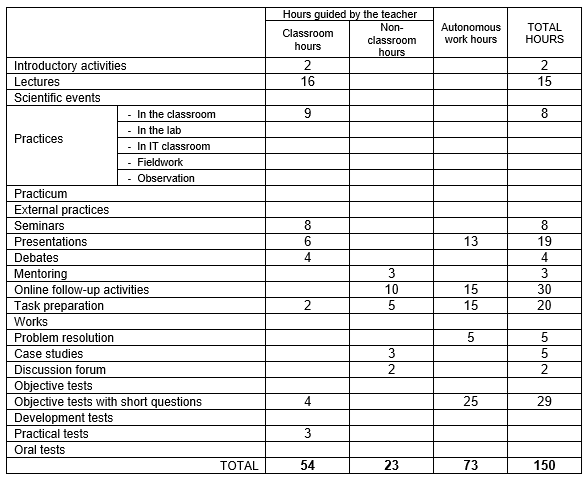
Teaching organization will include the following procedures:
1. Introductory activities
2. Theoretical activities
- Lectures
- Scientific events
3. Guided practical activities
- Classroom practices
- Seminars
- Presentations
- Debates
4. Mentoring
- Group mentoring
- Individual mentoring
- Online follow-up activities
5. Autonomous practical activities
- Task preparation
- Tasks and individual works
- Problem solution
- Case studies
6. Assessment and evaluation
- Objective tests with short questions
- Development tests
- Practical tests
7. Distribución de las Metodologías Docentes
8. Recursos
Libros de consulta para el alumno.
BASIC REFERENCES:
ANDERSON, Catherine (2017): Essentials of Linguistics. Hamilton: McMaster University.
ESCANDELL VIDAL, M. Victoria et al. (2014): Claves del lenguaje humano. Madrid: Ramón Areces.
YULE, George (2006): The study of language. Cambridge: Cambridge University Press.
The subject includes compulsory reading of 3 scientific papers that will be provided at the beginning of the course.
Otras referencias bibliográficas, electrónicas o cualquier otro tipo de recurso.
(I) HUMAN LANGUAGE ORIGIN AND EVOLUTION
Benítez-Burraco, A. (2009). Genes y lenguaje. Aspectos ontogenéticos, filogenéticos y cognitivos. Reverté.
Benítez-Burraco, A. (2023). El origen del lenguaje. De Adán a Babel. Almuzara.
Benítez-Burraco, A. y Barceló-Coblijn, L. (2015). El origen del lenguaje. Síntesis.
Boeckx, C. y Benítez-Burraco, A. (2016). Components of the language-ready brain. Frontiers in Psychology. https://www.frontiersin.org/research-topics/3624/components-of-the-language-ready-brain
(II) LANGUAGE STRUCTURE
Kracht, M. (2007). Introduction to Linguistics. UCLA.
Payne, T. E. (2006). Exploring language structure: a student’s guide. Cambridge University Press.
(III) LANGUAGE ACQUISITION
Bialystok, E. (2001). Bilingualism in development: language, literacy, and cognition. Cambridge University Press.
Mariscal, S. (2014). Adquisición del lenguaje. Síntesis.
(IV) LANGUAGE IN MIND AND BRAIN
Costa, A. (2019). El cerebro bilingüe. Penguin.
Diéguez Vide, F. (2019). Neuroanatomía funcional del lenguaje. Síntesis.
Friederici, A. D. (2017). Language in our brain; the origin of a uniquely human capacity. MIT Press.
Pinker, S. (2010). The language instinct: how the mind creates language. Harper Collins.
(V) GENERAL QUESTIONS
Gutiérrez-Rexach, J. (2016). Enciclopedia de lingüística hispánica. Routledge.
9. Evaluación
Criterios de evaluación.
1. Global written exam (50 %)
2. Group presentation (15 %)
3. Individual work (10 %)
4. Seminars / readings (20 %)
5. Class Participation (5 %)
Sistemas de evaluación.
- Evaluation of practical tasks in the classroom
- Evaluation of problem resolution and tasks conducted autonomously by the student
- Evaluation of group work
- Evaluation of active participation in the classroom and in the seminars
- Evaluation of written exam, in both theoretical and practical parts. Taking the written examen and achieving at least 5/10 in it is compulsory for passing the subject
|
EVALUATION METHODS |
||
|
Method |
Test type |
Rating |
|
Final exam (compulsory for passing) |
Written test with short questions and multiple-choice questions |
50 % |
|
Group presentation |
Correction of group presentation |
15 % |
|
Individual work |
Correction of individual presentation |
10 % |
|
Reading analysis |
Quizzes and individual activities |
20 % |
|
Participation |
Class debates and discussions |
5 % |
|
Total |
100 % |
|
|
Compensation and recovery are based on the same methods of evaluation and the same rating consideration. |
||
Recomendaciones para la evaluación.
Class attendance and classroom active participation will be valued with 6% of the global score.
Delays in handing practices won’t be accepted without a doctor’s note or other official document.
General questions
Assessment and evaluation revolve around four tasks:
- Theoretical and practical knowledge of the field of study / subject (CG1, CG3, CG4, CG5, CE1, CE2, CE3, CE4, CE5, CE6, CE7, CE8, CE9, CE10, CE11, CT1)
- Compulsory readings and seminars (CG3, CG4, CG5, CE4, CE5, CE7, CE8, CE10, CE11, CT1)
- Group work (CG2, CG3, CG4, CG6, CG7, CE4, CE5, CE7, CE8, CE10, CE11, CT1, CT2, CT3)
- Individual work (CG1, CG2, CG3, CG4, CG6, CG7, CT1, CT3)
Compensation and recovery:
- written exam (it is compulsory to take the exam and to achieve at least 5/10 in it for passing the subject)
- revision of group work during the course
- revision of individual work during the course
Rating consideration is the same as described in criteria, tools and methods of evaluation.