


ORAL COMMUNICATION IN EARLY LANGUAGE LEARNING ENVIRONMENTS
GRADO EN MAESTRO EN EDUCACIÓN PRIMARIA
Curso 2026/2027
1. Datos de la asignatura
(Fecha última modificación: 01-09-26 14:04)- Código
- 105239
- Plan
- 252
- ECTS
- 6.00
- Carácter
- OPTATIVA
- Curso
- 4
- Periodicidad
- Primer cuatrimestre
- Idioma
- ENGLISH
- Área
- FILOLOGÍA INGLESA
- Departamento
- Filología Inglesa
- Plataforma Virtual
Datos del profesorado
- Profesor/a
- Blanca García Riaza
- Grupo/s
- 1
- Centro
- Fac. Educación y Turismo
- Departamento
- Filología Inglesa
- Área
- Filología Inglesa
- Despacho
- Filología Inglesa (2ª planta)
- Horario de tutorías
- Por determinar
- URL Web
- http:english.usal.es
- bgr@usal.es
- Teléfono
- 920 353600 Ext. 3884
2. Recomendaciones previas
Activities in this course will be conducted in English, so students are expected to have reached at least a B1 entry level of English according to the Common European Framework of Reference for Languages (CEFR):
http://www.coe.int/T/DG4/Linguistic/CADRE_EN.asp
Students are recommended to develop their listening, speaking, reading and writing skills in English to reach at least a B2 level according to the CEFR.
3. Objetivos
Teach listening and listening skills being familiar with different categories of activities for young learners.
Play a model role drawing knowledge from Phonetics and Phonology.
Make effective use of Phonics in early language learning.
Teach pronunciation and stress, rhythm and intonation through (action) songs, chants, rhyming pairs, tongue twisters, etc.
Use instructional and formulaic language in English.
Elaborate and develop a complete set of expressions suitable for daily communication in the classroom context.
Use action games and practical activities for children conducive to improving their oral
skills.
4. Competencias a adquirir | Resultados de Aprendizaje
Básicas / Generales | Conocimientos.
- BP 11 To become familiar with the processes of interaction and communication in the classroom.
- DP28 To be able to express oneself orally and in writing in English language at least at level C1 according to the Common European Framework.
- DI 17 To recognize and value the importance of verbal and non verbal communication in the English classroom.
- DP 24 To know the teaching and learning process of the English language.
- DP 27 To be able to tackle language learning in multilingual settings.
- DP 29 To introduce English language content in the syllabus through appropriate teaching resources and to develop the relevant student competences.
- DI 20 To promote interest in the English language at the initial stage
Específicas | Habilidades.
Specific competences that students will be able to develop on completion of this course:
- To acquire linguistic knowledge and competence to work confidently in the Primary classroom.
- To acquire knowledge and competence to develop activities which can promote primary students’ oral communication and interaction.
- To demonstrate familiarity with the basic teaching strategies for communication used in a Primary classroom context.
- To acquire knowledge and competence to elaborate, develop and evaluate the language of the classroom.
- To identify expectations for children’s oral language use and development.
- To get knowledge and competence to plan lessons and activities for listening and speaking practice in the Primary classroom.
- To do some basic research on specific set targets of the teaching-learning process and develop presentation skills.
- To get knowledge and competence to elaborate strategies for self-instruction, critical thinking and professional development.
- To get ICT competence to generate teaching resources and materials suitable for the Primary classroom.
Transversales | Competencias.
⦁ BP 13 To promote cooperative work and individual effort.
⦁ BP 17 To become familiar with innovative teaching experiences in primary education and apply them.
⦁ BP 19 To become familiar with basic techniques and methodologies of educational research and be able to design innovative projects through the identification of evaluation criteria.
5. Contenidos
Teoría.
Teóricos
- MODULE 1. Communicative Methodologies in Language Teaching and Learning
- MODULE 2. Teaching Listening Skills
- MODULE 3. Speaking Skills in the English Classroom
- MODULE 4. English Phonetics and Phonology
- MODULE 5. Teaching Phonetics and Pronunciation
b) Prácticos
• MODULE 1. Review of examples of communicative methodologies and materials. Development of
proposals to promote oral skills in the foreign language classroom.
• MODULE 2. Analysis and design of listening comprehension activities.
• MODULE 3. Analysis and design of speaking activities.
• MODULE 4. Recognition of English phonemes and phonetic transcription.
• MODULE 5. Techniques and resources for phonetic practice in the classroom.
6. Metodologías Docentes
Según pág. 94 de la Memoria Verificada del Grado en Maestro en Educación Primaria
•
Lección Magistral. Explicaciones orales de contenidos
•
Trabajos personales
•
Trabajos en grupo, cooperativos
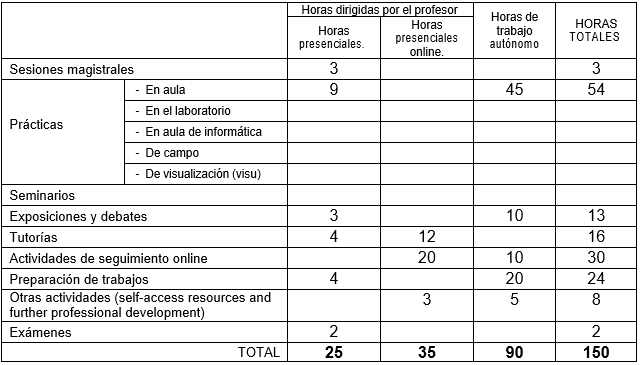
This course is designed to be taught through weekly face-to-face theoretical and practical sessions where both lectures and applied activities will be carried out.
Throughout the course, students will be provided with scientific readings, audiovisual materials and case studies to become familiar with the contents discussed in each thematic unit. For this purpose, the virtual learning platform of the University of Salamanca, Studium will be used. Ongoing autonomous study of the materials will be encouraged by the teacher who will support students online during the entire course.
In face-to-face sessions, students are expected to develop practical skills as they will accomplish tasks that require analyzing, describing, planning, collaborating and reasoning about teaching materials and methods displayed in real class samples that will be brought to discussion in class. They will also be expected to complete different group and individual tasks assigned for specific sessions, such as microteaching practices, presentations and case studies.
7. Distribución de las Metodologías Docentes
8. Recursos
Otras referencias bibliográficas, electrónicas o cualquier otro tipo de recurso.
Books:
Brown, G. and Yule, G. (1983) Teaching the Spoken Language. Cambridge: CUP. Byrne, D. (1987) Techniques for Classroom Interaction. London: Longman.
Eke, R. and Lee, J. (2009) Using Talk Effectively in the Primary Classroom. London and New York: Routledge.
Graham, C. (2006) Primary Resource Books for Teachers – Creating Chants and Songs. Oxford: OUP.
Grugeon et al. (2005) Teaching Speaking and Listening in the Primary School. 3rd edition. London: David Fulton Publishers.
Harmer, Jeremy 2008: The Practice of English Language Teaching. Harlow: Pearson Longman
Hughes, G. and Moate, J. (2007) Practical Classroom English. Oxford: OUP.
Jones, Deborah. (2006)Unlocking Speaking and Listening. London: David Fulton Publishers.
Johnson, K. and Morrow, K., eds. (1981) Communication in the Classroom. London: Longman.
Layton, L. and Deeny, K (2002) Sound Practice: Phonological Awareness in the Classroom. 2nd edition. London: David Fulton Publishers.
Lloyd, S. (1998) The Phonics Handbook. 3rd edition. Chigwell: Jolly Learning Ltd.
McMahon, A. (2002) An Introduction to English Phonology. Edinburgh: Edinburgh University Press.
Nicholson, T. (2006) Phonics Handbook. London: Whurr Publishers.
Scrivener, Jim 2004: Learning Teaching. A Guidebook for English Language Teachers. Oxford: Macmillan.
Sion, Chris. (2001) Creating conversation in Class. London: Delta Publishing.
Slattery, M. and Willis, J. (2001) English for Primary Teachers. Oxford: OUP. Turnbull, M. and Dailey-O’Cain, J., eds. (2009) First Language Use in Second and Foreign Language Learning. Bristol: Multilingual Matters.
Westwood, P. (2008) What Teachers Need to Know About Spelling. Camberwell, Vic.: ACER Press.
Willis, J. (1999) Teaching English Through English. London: Longman.
Other references:
Relevant reference and self-study documents in digital format (word, pdf, ppp, video- clips, audio-tracks) will be available for students in the Studium platform.
9. Evaluación
Criterios de evaluación.
- Evaluación continua (Asistencia presencial y participación activa y sistemática en tareas del
aula): 15%
- Examen escrito: 25%
- Exámenes prácticos: 20%
- Desarrollo de trabajos y prácticas grupales: 40% (Desarrollo de supuestos prácticos: 20% +
Trabajos teórico- prácticos: 20%)
Sistemas de evaluación.
Evaluación formativa y competencial basada en las capacidades de los alumnos para el análisis, la síntesis y el desarrollo de planificaciones de aula en las que demuestren una correcta asimilación de teorías y una actualizada puesta en práctica de recursos y estrategias metodológicas adaptadas a las necesidades educativas de los alumnos. Se utilizarán portafolios
de tareas, casos prácticos para su resolución y pruebas objetivas.
Recomendaciones para la evaluación.
Se recomienda encarecidamente asistir a clase y participar activamente, implicarse de forma regular en la realización de las tareas y consultar con frecuencia las lecturas de referencia y otros materiales didácticos y de aprendizaje.
Posibilidad de solicitar seguimiento no presencial por alguna de las causas recogidas en el
Reglamento de Evaluación de la Universidad de Salamanca/de la Facultad de Educación y Turismo, en cuyo caso la evaluación se lleva a cabo de la siguiente manera: 50% Examen escrito / 50% Trabajo teórico- práctico.