


GLOBAL SOCIETY
Estudios Globales / Global Studies
Curso 2026/2027
1. Subject Information
(Date last modified: 05-06-26 13:38)- Code
- 140500
- Plan
- 405
- ECTS
- 6.00
- Type
- Year
- 1
- Duration
- First semester
- Language
- ENGLISH
- Area
- -
- Departament
- -
- Virtual platform
Professor Information
- Profesor/a
- Zakaria Sajir
- Group/s
- Único
- Centre
- Fac. Derecho
- Office
- 415
- Office hours
- Under request by email
- Web address
- http://campus.usal.es/~acpa/
- zakaria.sajir@usal.es
- Phone
- -
2. Association of the subject matter within the study plan
Curricular area to which the subject matter pertains.
Sociology
Purpose of the subject within the curricular area and study plan.
Mandatory
Professional profile.
Undergraduate students
3. Prerequisites
TThere are no specific prerequisites beyond those established for the Degree in Global Studies.Students are expected to follow the course in English, attend classes regularly, complete the assigned readings and participate actively in classroom activities
4. Learning objectives
This course introduces students to the sociological analysis of global society. It does not aim to cover every aspect of globalisation exhaustively. Instead, it provides students with a structured framework for interpreting the main transformations, conflicts and inequalities that define the contemporary global condition.
By the end of the course, students should be able to:
- Understand key concepts and theories used in the study of global society and globalisation.
- Identify the main historical, political, economic and cultural processes shaping global interdependence.
- Analyse contemporary transformations in global governance, world order, inequality, security, migration, climate politics, digital capitalism and cultural diversity.
- Interpret empirical materials such as academic texts, reports, news, data, documentaries and policy debates.
- Connect global processes with concrete cases that illustrate contemporary global instability, geopolitical reconfiguration, migration regimes, climate disruption, digital transformation and changing patterns of inequality.
- Develop oral communication, teamwork, critical reading and evidence-based argumentation skills.
- Participate constructively in academic debates and formulate informed positions on global issues.
5. Contents
Theory.
Theory
The course approaches global society from a multidisciplinary perspective, with a strong grounding in sociology and International Relations. It combines theoretical discussion with empirical analysis of contemporary global problems.
Indicative topics include:
- Global Society as an object of analysis
- The roots and historical development of globalisation
- Main theories of globalisation and global modernity
- Capitalism, world-systems, inequality and uneven development
- States, sovereignty and global governance
- Multipolarity, China and the transformation of world order
- Geopolitical conflict, security, sanctions and strategic chokepoints
- Migration, borders, mobility and transnational social life
- Race, ethnicity, religion and cultural diversity in global societies
- Global culture, cultural homogenisation and cultural diversity
- Populism, democratic backsliding and threats to liberal democracy
- Climate crisis, energy transitions and ethical consumption
- Global health, pandemics and social vulnerability
- Digital capitalism, artificial intelligence, platforms and digital divides
- Gender and sexuality in global perspective
- Global cities, labour transformations and future social risks
Practice
Practical sessions will be based on readings, case studies, short reports, data, visual materials, documentaries, news analysis and structured debates.
Practical activities will focus on the application of course concepts to contemporary global processes, including global governance, inequality, migration, conflict, climate change, digital transformation, cultural diversity and transformations in the international order.
The course will normally include five compulsory readings or materials assessed through in-class practical activities. These materials may include academic articles, book chapters, institutional reports, newspaper articles, datasets, policy documents or audiovisual resources selected by the professor.
Students will be expected to read or prepare the assigned materials before class. Assessment will take place in class and will evaluate their capacity to understand the materials, identify their main arguments or evidence, connect them with course concepts and discuss them critically through individual or group exercises, oral discussion, short written outputs, conceptual application, case comparison or structured debate
Practice.
Practical sessions are designed to offer hands-on experience in analyzing empirical studies, encouraging discussions on various global societal issues. Each session, coupled with multimedia insights, enables students to contextualize theoretical knowledge in real-world scenarios.
6. Competences acquired
Basic / General.
These are taken from the official document on ‘competencias’, at https://www.usal.es/grado-en-estudios-globales-global-studies/objetivos
CB1. Students should demonstrate knowledge and understanding in their area of study, including aspects informed by advanced knowledge in the field.
CB2. Students should be able to apply their knowledge professionally and demonstrate competences through argumentation and problem-solving.
CB3. Students should be able to gather and interpret relevant data in order to make judgements on social, scientific or ethical issues.
CB4. Students should be able to communicate information, ideas, problems and solutions to both specialised and non-specialised audiences.
CB5. Students should develop the learning skills required to undertake further studies with a high degree of autonomy.
CG1. Apply acquired knowledge to solve concrete problems in new or unfamiliar environments within broader or multidisciplinary contexts.
CG2. Know and apply different research methods in the social sciences to analyse problems related to their field of study.
CG3. Develop organisational, planning and project coordination skills that facilitate teamwork.
CG4. Develop skills to design and implement practical plans and problem-solving programmes from a global or multidisciplinary perspective|
|
Specific.
|
CE2. Understand the historical dimension of political and social processes in the international framework. CE3. Understand the structure and functioning of different international organisations and/or integration processes. CE4. Understand current challenges for justice in a globalised world and analyse the situation of human rights globally. CE9. Understand the foundations of political economy in its financial and/or commercial dimensions. CE10. Identify and describe situations of poverty and inequality, their causal factors and their evolution in different cases. CE13. Understand decision-making and problem-solving mechanisms in the international context. CE14. Understand the role of media and information technologies in a global world. CE15. Understand the characteristics of collective action and the functioning of social movements. CE16. Understand migration processes over time and their political, economic and social consequences. CE17. Understand international security and its current challenges. CE18. Describe major international conflicts and identify their causal factors. CE20. Analyse and understand the political situation in a global environment, distinguishing sources of legitimacy, actors, institutions, the state and institutional design. |
Transversal.
The course also develops critical thinking, oral communication, teamwork, academic discussion, autonomous learning, synthesis of complex information, responsible use of sources and critical engagement with digital and AI-based tools
7. Teaching methods
|
The course will combine lectures, seminars, in-class discussions, debates, practical activities and students’ presentations. Teaching will make use of interactive didactic technologies, visual material, artificial intelligence tools and social networks. Teaching is in English. Lectures will introduce key concepts, theories and analytical frameworks. These sessions will provide students with the necessary tools to understand the main debates on global society. Seminars and practical sessions will focus on the discussion of readings, case studies, reports, data, documentaries and current events. Students will be expected to prepare the assigned materials in advance and participate actively in class. Group presentations will allow students to analyse a specific global issue in depth, connect it to the course concepts and communicate their findings clearly to the rest of the class. Class debates will be used to strengthen students’ capacity to build arguments, compare perspectives and critically assess evidence. AI-based tools may be used as part of the learning process when appropriate. Their use must support critical thinking, preparation, organisation, comparison of sources or reflection. Students remain responsible for the accuracy, quality and intellectual content of their work. Tutorials may be used to clarify doubts, guide presentations and support students who need additional academic orientation. |
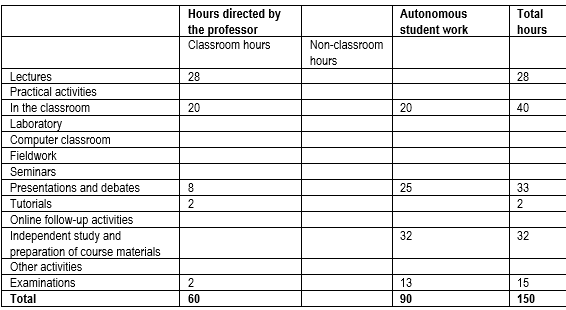
8. Anticipated distribution of the use of the different teaching methods
9. Resources
Reference books.
- Appadurai, A. (1996). Modernity at Large: Cultural Dimensions of Globalization. University of Minnesota Press.
- Bauman, Z. (1998). Globalization: The Human Consequences. Polity Press.
- Beck, U. (1999). World Risk Society. Polity Press.
- Castells, M. (2010). The Rise of the Network Society. Wiley-Blackwell.
- Eriksen, T. H. (2016). Overheating: An Anthropology of Accelerated Change. Pluto Press.
- Held, D., & McGrew, A. (2007). Globalization/Anti-Globalization: Beyond the Great Divide. Polity Press.
- Juergensmeyer, M., Sassen, S., Steger, M. B., & Faessel, V. (Eds.). (2019). The Oxford Handbook of Global Studies. Oxford University Press.
- Milanovic, B. (2016). Global Inequality: A New Approach for the Age of Globalization. Harvard University Press.
- Sassen, S. (2007). A Sociology of Globalization. W. W. Norton.
- Sassen, S. (2014). Expulsions: Brutality and Complexity in the Global Economy. Harvard University Press.
- Steger, M. B. (2023). Globalization: A Very Short Introduction. Oxford University Press.
- Tufekci, Z. (2017). Twitter and Tear Gas: The Power and Fragility of Networked Protest. Yale University Press.
Turner, B. S. (Ed.). (2010). The Routledge International Handbook of Globalization Studies. Routledge.
Other bibliographic references, electronic or other types of resources.
Additional academic articles, institutional reports, datasets, policy documents, news materials and audiovisual resources will be provided through Studium during the semester.
Students may also work with selected materials from international organisations and research institutions, including the United Nations, UN Trade and Development, the International Organization for Migration, the World Bank, the International Energy Agency, the International Labour Organization and other relevant sources.
Where directly relevant to specific course topics, additional materials may also include selected publications by the professor.
10. Assessment
Assessment criteria.
T
|
Consideraciones Generales |
|
The course follows a continuous assessment model as the ordinary evaluation system. Continuous assessment requires regular attendance, active participation and completion of the practical activities carried out during the semester. Students who accumulate more than four unexcused absences, or who fail to complete at least three of the five compulsory in-class practical activities, will not qualify for continuous assessment and will be assessed through the comprehensive written examination. Assessment will evaluate knowledge of course contents, capacity for critical analysis, use of evidence, clarity of oral communication, teamwork, engagement with readings and ability to connect theoretical concepts with empirical cases. The use of artificial intelligence tools may form part of the learning process when it supports preparation, comparison of sources, organisation of ideas, linguistic revision or critical reflection. Students must be able to explain, justify and critically assess any content or argument they present. Uncritical, misleading, undeclared or substitutive use of AI tools may be penalised when it prevents the assessment of the student’s own understanding, reasoning or academic work. |
|
Criterios de evaluación |
|
Assessment will evaluate knowledge of course contents, capacity for critical analysis, use of evidence, clarity of oral communication, teamwork, engagement with readings and ability to connect theoretical concepts with empirical cases. The use of artificial intelligence tools may form part of the learning process when it supports preparation, comparison of sources, organisation of ideas, linguistic revision or critical reflection. Students must be able to explain, justify and critically assess any content or argument they present. Uncritical, misleading, undeclared or substitutive use of AI tools may be penalised when it prevents the assessment of the student’s own understanding, reasoning or academic work. |
Evaluation systems.
|
Consideraciones Generales |
|
The course follows a continuous assessment model as the ordinary evaluation system. Continuous assessment requires regular attendance, active participation and completion of the practical activities carried out during the semester. Students who accumulate more than four unexcused absences, or who fail to complete at least three of the five compulsory in-class practical activities, will not qualify for continuous assessment and will be assessed through the comprehensive written examination. Assessment will evaluate knowledge of course contents, capacity for critical analysis, use of evidence, clarity of oral communication, teamwork, engagement with readings and ability to connect theoretical concepts with empirical cases. The use of artificial intelligence tools may form part of the learning process when it supports preparation, comparison of sources, organisation of ideas, linguistic revision or critical reflection. Students must be able to explain, justify and critically assess any content or argument they present. Uncritical, misleading, undeclared or substitutive use of AI tools may be penalised when it prevents the assessment of the student’s own understanding, reasoning or academic work. |
|
Criterios de evaluación |
|
Assessment will evaluate knowledge of course contents, capacity for critical analysis, use of evidence, clarity of oral communication, teamwork, engagement with readings and ability to connect theoretical concepts with empirical cases. The use of artificial intelligence tools may form part of the learning process when it supports preparation, comparison of sources, organisation of ideas, linguistic revision or critical reflection. Students must be able to explain, justify and critically assess any content or argument they present. Uncritical, misleading, undeclared or substitutive use of AI tools may be penalised when it prevents the assessment of the student’s own understanding, reasoning or academic work. |
Assessment recommendations.
Students are strongly encouraged to attend classes regularly, prepare the assigned materials in advance and participate actively in discussions and practical activities.
Students should avoid leaving preparation for presentations until the last moment. The course requires continuous engagement with readings, concepts and current global developments.
Students are encouraged to contact the professor during office hours if they have doubts about the course, the readings, the group presentation or the assessment system.