


DEVELOPMENT POLITICS
Estudios Globales / Global Studies
Curso 2026/2027
1. Subject Information
(Date last modified: 25-05-26 13:47)- Code
- 140512
- Plan
- 405
- ECTS
- 6.00
- Type
- Compulsory
- Year
- 2
- Duration
- First semester
- Language
- ENGLISH
- Area
- ECONOMÍA APLICADA
- Departament
- Economía Aplicada
- Virtual platform
Professor Information
- Profesor/a
- Luis Garrido Mateos
- Group/s
- Único
- Centre
- Fac. Economía y Empresa
- Office
- 113 de la Facultad de Derecho
- Office hours
- By appointment (via email)
- Web address
- https://derecho.usal.es/staff/garrido-mateos-luis/
- luisgarrimateos@usal.es
- Phone
- -
2. Association of the subject matter within the study plan
Curricular area to which the subject matter pertains.
Global Economy
Purpose of the subject within the curricular area and study plan.
The purpose of this course is to provide students an insight on how public policies for development purposes are developed, implemented and assessed.
Professional profile.
Public sector, private sector, research, international cooperation, consulting, academia, and public policy development and analysis, among others.
3. Prerequisites
No specific previous skills are required.
4. Learning objectives
To help students to understand development policy development; public policy monitoring, supervision, and evaluation.
5. Contents
Theory.
The course will address issues related to the following topics
- Development Policy.
- Public Policy Evaluation.
- Public Infrastructure and Urban Transport.
- Health Policy.
- Educational Policy.
- Energy Policy.
- Environmental Policy.
- Macroeconomic and Fiscal Policy.
Practice.
The course on Development Politics may include a combination of two different practical activities, such as:
- Seminars: Students will analyze suggested texts and undertake writing activities every week. Students will have to present written essays with their own thoughts and conclusions through Studium, and participate in class discussion and debates.
- Public Policy Research Project: Students will assess a public policy, prepare a report and present it in class.
The professor reserves the right to adapt the specific design, timing and implementation of these practical activities to the characteristics of the group and the pedagogical development of the course. Any relevant change will be duly communicated through Studium.
6. Competences acquired
Basic / General.
BS1. Students must demonstrate to understand and manage specific knowledge for this area of study, based on general higher education. This knowledge is commonly based on advanced text books, but may also include some aspects belonging to the forefront of its area of study.
BS2. Students must demonstrate to know how to apply the acquired knowledge to their professional career or to their vocation in a professional way, and to have all required competencies that are usually demonstrated by building and defending arguments, and by solving problems within the area of study.
BS3. Students must show ability to gather and interpret relevant data, usually from their area of study, to make judgements based on a reflection on relevant topics from a social, scientific and ethical perspective.
BS4. Students must be able to transmit information, ideas, problems and solutions to a specialized and non-specialized audience.
GS1. To apply the acquired knowledge to solve specific problems in new or unknown environments, within a wider (or multidisciplinary) contexts.
GS2. To know and apply several research methods in the area of social sciences with the purpose of analyzing problems linked to their area of expertise.
GS3. To develop organizational skills, task planning and project coordination, in order to foster teamwork.
GS4. To develop a set of skills to design and implement plans and problem-solving programs, from a global and multidisciplinary perspective.
Specific.
SS10. To identify and describe poverty and inequality situations. Identify causal factors and analyze the evolution and achievements of different cases.
SS13. To identify and understand the different decision-making and problem-solving mechanisms within he international context..
7. Teaching methods
Master classes and practical sessions. Both formats require active participation by students.
8. Anticipated distribution of the use of the different teaching methods
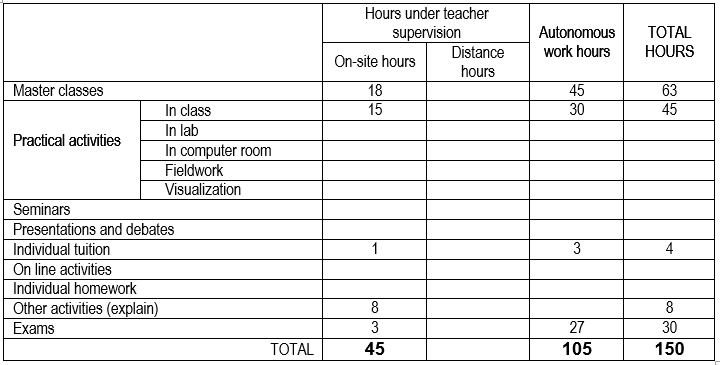
9. Resources
Reference books.
Basic text book:
Guess, George M., and Thomas Husted (2016). International Public Policy Analysis. Routledge.
Additional references:
Hammet, Daniel (2024). Global Development. The Basics. 1st edition. Routledge
Howlett, Michael (2019). Designing Public Policies. Principles and Instruments. 2nd edition. Routledge.
Birkland, Thomas A. (2020). An Introduction to the Policy Process. 5th edition. Routledge.
de Janvry, Alain; Elisabeth Sadoulet (2021). Development Economics. 2nd edition. Routledge.
Carbonnier, G. (Ed.) (2012). International Development Policy. Aid, Emerging economies and Global Policies. Palgrave Macmillan.
Karlan, D. and Jacob Appel (2016). Failing in the Field. What can we Learn when Field Research Goes Wrong. Princeton University Press.
Kragelund, Peter (2019). South-South Development. Routledge
Lanoszka, Anna (2018). International Development. Routledge.
Kütting, Gabriela, and Kyle Herman (2018). Global Environmental Politics. Concepts, Theories and Case Studies. 2nd Edition. Routledge.
Death, Carl (2013). Critical Environmental Politics. 1st Edition. Routledge.
Any article, lecture, paper or document uploaded to Studium
10. Assessment
Assessment criteria.
|
General Considerations |
|
Students must demonstrate a sufficient level of the required general, basic and specific skills to pass the course. |
|
Evaluation Criteria |
|
The evaluation includes theory and practice, and it is structured in two different parts: continuous evaluation and a final exam. Continuous work and the final exam represent 50 % and 50 % of the final grade, respectively. It is mandatory to successfully perform on both parts of the evaluation to pass the course (At least 25% of the grade on each). |
Evaluation systems.
|
Evaluation Activities |
|
Continuous evaluation (maximum 50 % of the final grade): Seminars (Weekly practical activities). Public Policy Research Project.
Final exam (maximum 60% of the final grade): The final exam includes theoretical and practical knowledge acquired over the course. It will be based on the concepts studied in the master classes and the weekly seminars. |
Assessment recommendations.
|
Recommendations for evaluation |
|
Constant work during the different activities in which the continuous evaluations is divided. Active participation in theoretical classes and seminars. |
|
Recommendations to pass the course |
|
Constant work during the different activities in which the continuous evaluations is divided. Active participation in theoretical classes and seminars. |