


SOCIAL AND POLITICAL MOVEMENTS IN A GLOBALIZING WORLD
Estudios Globales / Global Studies
Curso 2026/2027
1. Subject Information
(Date last modified: 05-06-26 13:51)- Code
- 140519
- Plan
- 405
- ECTS
- 6.00
- Type
- Compulsory
- Year
- 2
- Duration
- Second semester
- Language
- ENGLISH
- Area
- SOCIOLOGÍA
- Departament
- Sociología y Comunicación
- Virtual platform
Professor Information
- Profesor/a
- Kerman Calvo Borobia
- Group/s
- Único
- Centre
- Fac. Ciencias Sociales
- Office
- 414
- Office hours
- Horario de mañana, de 10:30 a 13:00, de lunes a jueves. Se recomienda contactar previamente con el profesor.
- Web address
- http://diarium.usal.es/kerman/presentacion/
- kerman@usal.es
- Phone
- Ext 3520
2. Association of the subject matter within the study plan
Curricular area to which the subject matter pertains.
Social Sciences
Purpose of the subject within the curricular area and study plan.
Development of social science tools for the understanding of specific topics relating to protest and mobilization
Professional profile.
International organizations, political analysis, political counseling
3. Prerequisites
A revision of theories about globalization
4. Learning objectives
- To familiarize students with the plurality of manifestations that contentious politics take globally.
- To familiarize students with the successes and failures of social movements worldwide.
- To help students develop a critical reading of contemporary social and economic dynamics.
- To help students communicate ideas.
5. Contents
Theory.
-
- Political Movements and Cultural Movements.
- Protest.
- International Networked Advocacy.
- Movements in the Global South
- The Transnational Women's movements.
- Movements for ethnic rights.
6. Competences acquired
Basic / General.
These are taken from the official document on ‘competencias’, at https://www.usal.es/grado-en-estudios-globales-global-studies/objetivos
CB2. Que los estudiantes sepan aplicar sus conocimientos a su trabajo o vocación de una forma profesional y posean las competencias que suelen demostrarse por medio de la elaboración y defensa de argumentos y resolución de problemas dentro de su área de estudio.
CB3. Que los estudiantes tengan la capacidad de reunir e interpretar datos relevantes normalmente dentro de su área de estudio de para emitir juicios que incluyan una reflexión sobre temas relevantes de índole social, científica o ética.
CB5. Que los estudiantes hayan desarrollado aquellas habilidades de aprendizaje necesarias para emprender estudios posteriores con un alto grado de autonomía.
CG1 - Aplicar los conocimientos adquiridos para resolver problemas concretos en entornos nuevos o poco conocidos dentro de contextos más amplios (o multidisciplinares).
CG2 - Conocer y aplicar los distintos métodos de investigación en el ámbito de las ciencias sociales para analizar problemas en relación con su especialidad.
CG3 - Desarrollar habilidades de organización, planificación de tareas y coordinación de proyectos que faciliten el trabajo en Equipo.
Specific.
CE4 - Conocer los retos actuales para la justicia en un mundo globalizado así como el análisis de la situación de los derechos humanos en el mundo.
CE10 - Identificar y describir situaciones de pobreza y desigualdad. Identificar factores causales así como analizar la evolución y logro de distintos casos.
CE15 - Conocer las características de la acción colectiva y entender el funcionamiento de los movimientos sociales y sus principales características.
7. Teaching methods
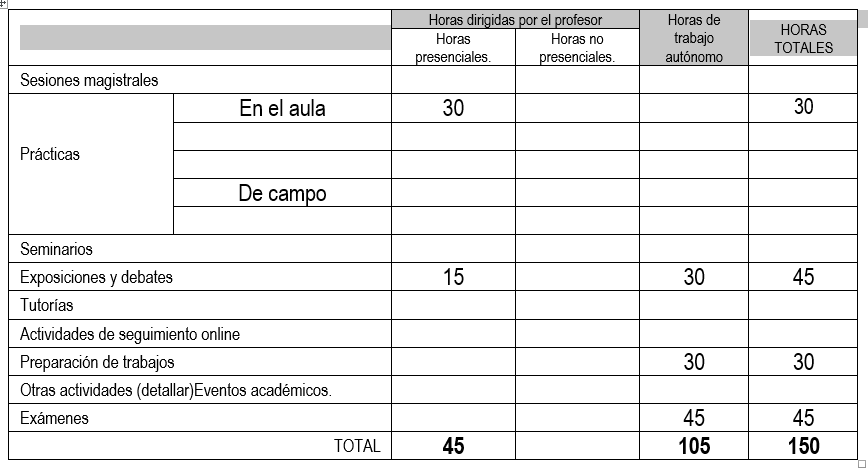
The course will combine lectures (clases magistrales) with in class discussions, debates and students’ presentations. Teaching will make use of interactive didactic technologies, visual material, AI and social networks. Teaching is in English.
8. Anticipated distribution of the use of the different teaching methods
9. Resources
Reference books.
- Bennett, W. L., Della Porta, D., Diani, M., Johnson, E., Kolb, F., McAdam, D., ... & Sikkink, K. (2004). Transnational protest and global activism. Rowman & Littlefield Publishers.
- Fominaya, C. F. (2014). Social movements and globalization: How protests, occupations and uprisings are changing the world. Macmillan International Higher Education.
- Smith, J., & Wiest, D. (2012). Social movements in the world-system: The politics of crisis and transformation. Russell Sage Foundation.
- Tarrow, S. (2005). The new transnational activism. Cambridge university press.
- Tufekci, Z. (2017). Twitter and tear gas: The power and fragility of networked protest. Yale University Press.
- Kaldor, M. (2013). Global civil society: An answer to war. John Wiley & Sons.
- Smith, J. (2008). Social movements for global democracy. JHU Press.
- Guilhot, N. (2005). The democracy makers: Human rights and international order. Columbia University Press.
- Chabot, S., Ayres, J. M., & Caniglia, B. S. (2002). Globalization and resistance: Transnational dimensions of social movements. Rowman & Littlefield.
10. Assessment
Assessment criteria.
|
Consideraciones Generales |
|
Students must demonstrate a sufficient level of the required skills to pass the course. |
|
Criterios de evaluación |
|
Evaluation will be based on the following criteria:
|
Evaluation systems.
First Assessment
- In-class evaluation of compulsory readings (3 × 15%).
- Preparation of a scientific infographic (25%).
- Final exam (30%).
Second Assessment
Oral examination.
Assessment recommendations.
Intense individual work with course materials.
Contact professor with doubts at any point during the course.
Do not miss lectures!
Recomendaciones para la recuperación:
Intense individual work with course materials.
Contact professor with doubts at any point during the course.
Do not miss lectures!