


GENDER, POLITICS, AND SOCIETY
Estudios Globales / Global Studies
Curso 2026/2027
1. Subject Information
(Date last modified: 08-06-26 10:55)- Code
- 140533
- Plan
- 405
- ECTS
- 3.00
- Type
- Year
- 3
- Duration
- Second semester
- Language
- ENGLISH
- Area
- -
- Departament
- -
- Virtual platform
Professor Information
- Profesor/a
- Julián Alejandro Martínez Ramos
- Group/s
- sin nombre
- Centre
- Fac. Ciencias Sociales
- Office
- Área de Ciencia Política / Planta Jardín
- Office hours
- Jueves y viernes de 15:00 a 17:00
- Web address
- https://juliantropo.quarto.pub/methods/
- jamr@usal.es
- Phone
- 685585638
2. Association of the subject matter within the study plan
3. Prerequisites
4. Learning objectives
This course does not attempt to cover in depth all the open debates in the field of Gender Studies. Rather, its aim is to supply the students with the tools for theoretical and empirical analysis with a look at the main actual debates in the field. Some of the readings include more technical components, but it does not presuppose any extra requirements for taking the course.
5. Contents
Theory.
- Introduction to media and communication studies.
- Media history: national and international roots.
- Media, culture and national identity.
- Media, transnational discourses and power.
- Propaganda and persuasion.
- Political economy of communication.
7. Media and cultural policies.
Practice.
First part will include the topics of Definitions and Frameworks of the Sociology of Gender (Individual, Interactional and Institutional). Within these topics, we will discuss the problems of Sex vs Gender debate, Gender Socialization, the ‘Doing Gender’ perspective, and Gendered Organizations.
The second part will consist in critical reviews and debates of empirical studies and research about five main issues within the field of Gender Studies. These issues are: Gender and Work; Gender and unpaid work and care; Gender and Politics; Gender Beyond Binarism; and G ender and Violence.
6. Competences acquired
Basic / General.
Students are expected to enroll into an active learning process. They will be able to analyze and apply different perspectives about the main debates on the field of Gender Studies from a critical reasoning. They will be able to build strong arguments within the discipline (CB2). Also, students will be qualified to understand and interpret relevant data to elaborate insightful judgments within the field of Gender Studies (CB3) and solve specific problems in larger and multi-disciplinary contexts (CG1). Finally, the acquisition of these skills will be relevant and necessary for those students interested in advancing their careers and pursuing postgraduate studies (CB5).
Specific.
|
More specifically, students will be able to recognize historical elements of social and political processes (CE2) which are relevant to identify and describe contexts of inequality related to gender differences (CE10). |
7. Teaching methods
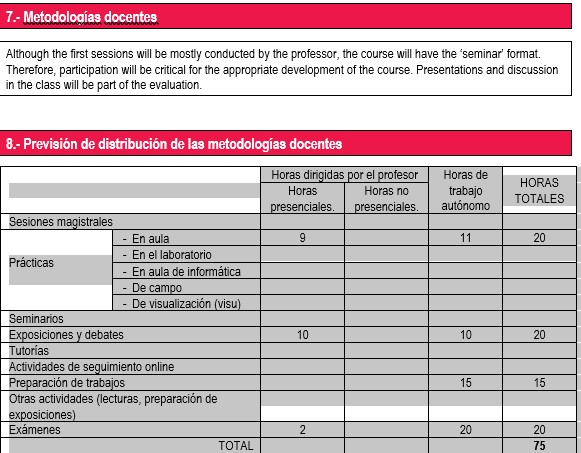
Although the first sessions will be mostly conducted by the professor, the course will have the ‘seminar’ format. Therefore, participation will be critical for the appropriate development of the course. Presentations and discussion in the class will be part of the evaluation.
8. Anticipated distribution of the use of the different teaching methods
9. Resources
Reference books.
- Anderson, B. (1983). Imagined Communities. Reflections on the Origin and Spread of Nationalism. London: Verso.
- Hall, Stuart (Ed.) (1997). Representation. Cultural Representations and Signifying Practices. London: Sage Publications.
- Iosifidis, P. (2011). Global Media and Communication Policy. New York: Palgrave Macmillan.
- Jowett, G. S. & O’Donnell, V. (2015). Propaganda and Persuasion. [Sixth edition]. London: Sage Publications.
- Mac Bride, S., Many Voices, One World: Communication and Society Today and Tomorrow. 1980, London: Kogan
- Nye, J. S. (2004). Soft Power: The Means to Success in World Politics. New York: Public Affairs.
Thompson, J.B. (1995). The Media and Modernity: A Social Theory of the Media. Cambridge: Polity Press
Other bibliographic references, electronic or other types of resources.
- West, C & Zimmerman, D. (1987) Doing Gender. Gender and Society, 1(2), 125-151.
- Acker, J. (1990) Hierarchies, Jobs, Bodies: A Theory of Gendered Organizations. Gender and Society, 4(2), 139-158
- Hakim, C. (2006) Women, careers, and work-life preferences. British Journal of Guidance & Counselling. 34(3):279-294
- Blanhette, T y Da Silva, A. P. (2018) Classy Whores: Intersections of Class, Gender, and Sex Work in the Ideologies of the Putafeminista Movement in Brazil. Contexto Internacional, 40(3)
- Sevilla-Sanz, A. et al (2010) Gender Roles and the Division of Unpaid Work in Spanish Households. Feminist Economics. 16(4). 137-184. Paxton, P et al. (2007). Gender in Politics. Annual Review of Sociology, 33(1), 263–284.
- Beall, V. & Barnes, T. (2020): Mapping Right-Wing Women’s Policy Priorities in Latin America, Journal of Women, Politics & Policy
Darwin, H. (2017) Doing Gender Beyond the Binary: A
10. Assessment
Assessment criteria.
|
Consideraciones Generales |
|
Although the first sessions will be mostly conducted by the professor, the course will have the ‘seminar’ format. Therefore, participation will be critical for the appropriate development of the course. Presentations and discussion in the class will be part of the evaluation. |
Criterios de evaluación
Group activities (50%): there will be at least two mandatory assignments to develop in groups during the course.
- Final exam (40%): it will be proposed to control the reading and understanding of mandatory readings and class presentations.
- Attendance and participation (10%): participation grades will be based on assistance controls and actively participating in activities and discussions proposed in class.
Evaluation systems.
|
Exams (40%)
Presentation (20%)
Responses (15%)
Short written assignment (25%)
|
Assessment recommendations.
Read all the texts and attend to class