


GLOBAL MIGRATIONS, HUMAN TRAFFICKING AND REFUGEES
Estudios Globales / Global Studies
Curso 2026/2027
1. Subject Information
(Date last modified: 05-06-26 14:47)- Code
- 140522
- Plan
- 405
- ECTS
- 6.00
- Type
- Year
- 3
- Duration
- First semester
- Language
- ENGLISH
- Area
- -
- Departament
- -
- Virtual platform
Professor Information
- Profesor/a
- Tatiana Eremenko
- Group/s
- sin nombre
- Centre
- Fac. Ciencias Sociales
- Office
- Edificio FES, 417
- Office hours
- Wednesday 16:00-18:00. Thursday 8:00-10:00. Please contact in advance to schedule a meeting
- Web address
- https://produccioncientifica.usal.es/investigadores/262705/detalle
- teremenko@usal.es
- Phone
- 666 59 03 92
2. Association of the subject matter within the study plan
3. Prerequisites
There are no specific or extra requirements to take this course.
4. Learning objectives
The objective of this course is to equip students with analytical and conceptual tools from social sciences (sociology, demography, economics, political science…) to analyze the phenomenon of global migration. By the end of the course, students will be able to:
- Identify and apply core concepts and definitions related to global migration, refugees and human trafficking
- Compare and evaluate different theoretical perspectives and methodological approaches used to analyze these phenomena
- Describe and interpret current empirical patterns and trends in global migration, refugees and human trafficking
- Analyze the role of different actors, especially States, in regulating and shaping these phenomena
Critically evaluate the representation of migration and human trafficking in public discourse and societal contexts
5. Contents
Theory.
|
Teoría- Theory and Literature |
|
Migration and mobility: concepts and definitions Patterns and trends in global migration Migration drivers and mechanisms Migration policies Forced migration and asylum Human trafficking Gender and migration Children and migration |
6. Competences acquired
Basic / General.
|
Students are expected to enrol into an active learning process. They will be able to analyse and apply different perspectives about the main debates on the field of Global Migrations, Human Trafficking and Refugees from a critical reasoning. They will be able to build strong arguments within the discipline (CB2). Also, students will be qualified to understand and interpret relevant data to elaborate insightful judgments within the field of Global Migrations, Human Trafficking and Refugees (CB3) and solve specific problems in larger and multi-disciplinary contexts (CG1). Finally, the acquisition of these skills will be relevant and necessary for those students interested in advancing their careers and pursuing postgraduate studies (CB5). |
Specific.
|
More specifically, students will be able to recognize historical elements of social and political processes (CE2) which are relevant to identify and describe contexts global migrations and refugees (CE10). |
7. Teaching methods
This course combines several teaching methods to foster active learning:
- Lectures: The professor will introduce key theories, concepts, and methods used to study migration and human trafficking, providing foundational knowledge and analytical frameworks
- Class discussions and debates: Students will engage in discussions based on assigned readings and case studies, as well as structured debates on specific topics related to migration and human trafficking
- Group work: Students will collaborate in groups to explore topics in greater depth, working on both assigned themes and self-selected areas of interest
- Individual assignments: A written essay assignment will provide opportunities for students to reflect critically on course content and develop independent analytical perspectives
Active participation is essential for this course. Students are expected to:
- Complete assigned readings before each session
- Engage actively in class discussions and debates
- Analyze case studies and empirical data on migration and human trafficking
Preparation time outside of class is significant and necessary for meaningful participation
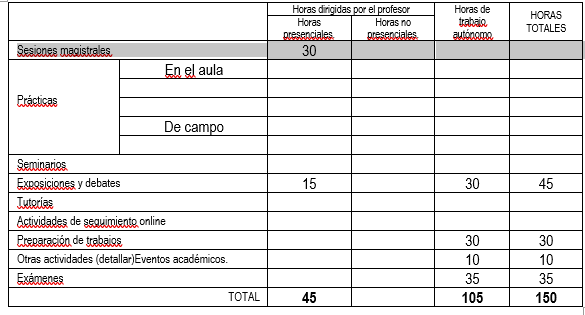
8. Anticipated distribution of the use of the different teaching methods
9. Resources
Reference books.
Main references:
de Haas, H., Castles, S. and M. J. Miller. The Age of Migration: International Population Movements in the Modern World (2014). New York :
Main references:
Gold, S. J., & Nawyn, S. J. (Eds). (2019). Routledge international handbook of migration studies (Second edition). Routledge.
Brettell, C., & Hollifield, J. F. (Eds.). (2023). Migration theory: talking across disciplines (Fourth edition). Routledge.
Hollifield, J. F., Martin, P. L., Orrenius, P. M., & Héran, F. (Eds). (2022). Controlling immigration: A comparative perspective (Fourth edition). Stanford University Press.
Additional references will be provided at the start of the semester (through the Studium platform).
Other bibliographic references, electronic or other types of resources.
Reports and data sources:
IOM World Migration report: https://worldmigrationreport.iom.int/
UNHCR Global Report: https://www.unhcr.org/what-we-do/reports-and-publications/global-report
UNODC Global Report: https://www.unodc.org/unodc/data-and-analysis/glotip.html
Migration Data Portal: https://www.migrationdataportal.org/
10. Assessment
Assessment criteria.
|
Consideraciones Generales |
|
Assessment is designed to encourage active and consistent participation throughout the course. It combines continuous evaluation during the semester – including an individual essay, group presentation, and class participation – with a final written exam. |
Evaluation systems.
|
Continuous assessment structure:
Attendance requirement for continuous assessment: students must attend at least 75% of sessions to be eligible for continuous assessment. Students attending fewer sessions will be evaluated through the final assessment system, regardless of other work submitted.
Final assessment structure:
|
Assessment recommendations.
|
Recomendaciones para la evaluación. |
|
Regular attendance, thorough preparation of assigned readings, and active participation in class discussions and debates are essential for success in this course. If you have questions or need support during the semester, please reach out via email or attend office hours. |
|
Recomendaciones para la recuperación. |
|
Second-session evaluation follows the same structure as the final assessment:
Students are strongly encouraged to attend office hours after the first session to discuss their performance and prepare effectively for the second session. |