


TERRORISM, INSURGENCY, AND POLITICAL VIOLENCE
Estudios Globales / Global Studies
Curso 2026/2027
1. Subject Information
(Date last modified: 28-05-26 14:24)- Code
- 140535
- Plan
- 405
- ECTS
- 6.00
- Type
- Opcional
- Year
- 3
- Duration
- Second semester
- Language
- ENGLISH
- Area
- CIENCIA POLÍTICA Y DE LA ADMINISTRACIÓN
- Departament
- Derecho Público General
- Virtual platform
Professor Information
- Profesor/a
- Elena María Gil Moreno
- Group/s
- Único
- Centre
- Fac. Derecho
- Office
- Espacio ACPA, Planta Jardín
- Office hours
- Under request by email
- Web address
- https://produccioncientifica.usal.es/investigadores/57649/detalle
- elenagm@usal.es
- Phone
- 923 29 44 00 - Ext. 1617
2. Association of the subject matter within the study plan
3. Prerequisites
None
4. Learning objectives
Throughout this course students will reflect on the nature of political violence, its causes, and consequences. They will also gain a broad view of the interconnection of conflicts around the world and their relationship to imperialist policies.
At the end of this course students will be able to:
- Differentiate the diverse types of political violence that have emerged in different regions of the world.
- Understand the complexity of the phenomena of political violence and the politics of counterterrorism and counterinsurgency.
- Identify the challenges of new and old forms of political violence that we are facing today.
5. Contents
Theory.
Block 1: Conceptualizations of Terrorism
- Traditional and Critical Approaches to Security Studies
Block 2: Situating International Terrorism: Causes, Transformation and the International War on Terror
- Colonial borders in the end of the 90s
- Preventive War, a Doctrine
- Al-Qaeda and its evolution to the Islamic State
- Global Terrorism Index, Al-Qaeda in the North of Africa
Block 3: Rethinking Counter-Terrorism: Preventing Violent Radicalization in the Face of Current Terrorism Trends
- Moving beyond international wars against external and internal enemies
- Humanitarian approaches for the prevention of political violence
- Peacebuilding processes of political violence
Block 4: Communist Internationalism during the Cold War: From Sierra Maestra to Luanda
- Decolonization and wars of independence: Protracted People's War and Foquismo
- Security Doctrine against the “internal enemy”: The CounterInsurgent War
- Armed groups emerging from the counter-insurgency warfare doctrine
Block 5: From Counterinsurgency Warfare to Criminal Governance and its Securitizing Response
- Systemic violence in Latin America as a consequence of the counter-insurgency doctrine
- From counter-insurgency warfare to the war on drugs
- Pacification of criminal governance from the local level: lessons from communal practices and non-aggression pacts
Practice.
Case studies
6. Competences acquired
Basic / General.
CB2, CB3, CB4 CG1, CG2, CG4
Specific.
CE2, CE15, CE20
Transversal.
Lecture, Seminars, Debates, practical assignments
7. Teaching methods
Lecture, Seminars, Debates, practical assignments
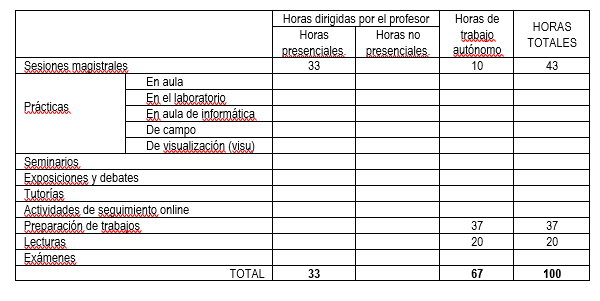
8. Anticipated distribution of the use of the different teaching methods
9. Resources
Reference books.
Ahmad, A. (2017). Jihad & Co.: black markets and Islamist power. Oxford University Press.
Akilu, F. (2021). Peaceful Societies and Leaving No One Behind. In Fulfilling the Sustainable Development Goals (pp. 407-416). Routledge.
Alonso, R. et al. (2008). Radicalization Processes Leading to Acts of Terrorism, European Commission
Apter, D. (1997). The legitimization of violence. NYU Press.
Asri, F. E., & Mesa, B. (2021). Extrémisme (s) violent (s) en perspective: jeunes et femmes dans le contexte marocain. Extrémisme (s) violent (s) en perspective: jeunes et femmes dans le contexte marocain, 139-158.
Body-Gendrot, S., & Spierenburg, P. (Eds.). (2008). Violence in Europe. Springer-Verlag New York.
Booth, K. (Ed.). (2005). Critical security studies and world politics (pp. 259-278). London: Lynne Rienner Publishers.
Brown, M. E., Cote Jr, O. R., Lynn-Jones, S. M., & Miller, S. E. (Eds.). (2010). Contending with Terrorism: Roots, strategies, and responses. MIT Press.
Buzan, B., Wæver, O., & De Wilde, J. (1998). Security: A new framework for analysis. Lynne Rienner Publishers.
Cabnal, L. (2017). TZK'AT, Red de sanadoras ancestrales del feminismo comunitario desde Iximulew-Guatemala. Ecología política, 98-102.
Cabnal, L. (2010). Acercamiento a la construcción de la propuesta de pensamiento epistémico de las mujeres indígenas feministas comunitarias de Abya Yala. Momento de paro Tiempo de Rebelión, 116(3), 14-17.
Calle, L., & Sánchez-Cuenca, I. (2011). What we talk about when we talk about terrorism. Politics & Society, 39(3), 451-472.
Cockburn, P. (2016). Chaos & Caliphate: Jihadis and the West in the Struggle for the Middle East, Or Books Llc
Della Porta, D. (2018). Radicalization: A relational perspective. Annual Review of Political Science, 21(1), 461-474.
Durán-Martínez, A. (2018). The Politics of Drug Violence: Criminals, Cops and Politicians in Colombia and Mexico. Oxford University Press.
Fanon, F. (1961). The Wretched of the Earth (Les Damnés de la Terre). François Maspero.
Grajales, J. (2013). State Involvement, Land Grabbing and Counter-Insurgency in Colombia (Development and Change), 44(2) pp 211-232
Hoffman, B. (2018). Inside terrorism. In Inside Terrorism. Columbia University Press.
Hoffman, B., & Reinares, F. (Eds.). (2014). The evolution of the global terrorist threat: From 9/11 to Osama bin Laden's death. Columbia University Press.
Johnston, J. (2000). Pedagogical guerrillas, armed democrats, and revolutionary counterpublics: Examining paradox in the Zapatista unprising in Chiapas Mexico. Theory and Society, 29(4), 463-505
Koppel, T. (2015). Lights out: a cyberattack, a nation unprepared, surviving the aftermath. Broadway Books.
Lessing, B. (2021). Conceptualizing criminal governance. Perspectives on Politics, 19(3), 854-873
López, T. M. (2018). Terrorismo y comportamiento político: España y el caso de ETA, Doctoral dissertation, Universidad Autónoma de Madrid.
Mbembe, A. (2008). Necropolitics. Palgrave Macmillan UK.
McMahon, Robert J. (2003). The Cold War: A Very Short Introduction, Oxford University Press
Mesa, B. (2017). Le rôle transformateur des groupes armés du nord du Mali: de l'insurrection djihadiste et sécessionniste au crime organisé (1996-2017) (Doctoral dissertation, Université Grenoble Alpes (ComUE)).
Mesa, B. (2025). The failure of the West in Africa: The new threat we don't want to see. Cordoba: Almuzara.
Moghaddam, F. M. (2005). The Staircase to Terrorism: A Psychological Exploration. American Psychologist, 60(2), 161–169.
Moskalenko, S., & McCauley, C. (2008). Mechanisms of Political Radicalization: Pathways Toward Terrorism. Terrorism and Political Violence, 20(3), 415-433.
Mueller, J. (2008). The Atomic Terrorist: Assessing the Likelihood. prepared for presentation at the Program on International Security Policy, University of Chicago, 15.
National Consortium for the Study of Terrorism and Responses to Terrorism (2020). Global Terrorism Index 2020, Institute for Economics and Peace
Neumann, P. R. (2016). Radicalized: new jihadists and the threat to the West. Bloomsbury Publishing.
Richards, A. (2014). Conceptualizing terrorism. Studies in Conflict & Terrorism, 37(3), 213-236.
Said, E. W. (1988). The Essential Terrorist. En Blaming the Victims: Spurious Scholarship and the Palestinian Question. Verso.
Sageman, M. (2004). Understanding Terror Networks. University of Pennsylvania Press.
Orentlicher, D. (2018). Some kind of justice: The ICTY's impact in Bosnia and Serbia. Oxford University Press.
Sánchez-Cuenca, I., & De la Calle, L. (2009). Domestic terrorism: The hidden side of political violence. Annual Review of Political Science, 12, 31-49.
Shapiro, J. N. (2013). The terrorist's dilemma. In The Terrorist's Dilemma. Princeton University Press.
Tilly, C. (2003) The Politics of Collective Violence. New York: Cambridge University Press
Trejo, G., & Ley, S. (2018). Why did drug cartels go to war in Mexico? Subnational party alternation, the breakdown of criminal protection, and the onset of large-scale violence. Comparative Political Studies, 51(7), 900-937.
Tzul Tzul, G. (2018). Sistemas de gobierno comunal indígena: Mujeres y tramas de parentesco en Chuimeq'ena'. México: Instituto Amaq.
United Nations Office on Drugs and Crime (2012). The Use of the Internet for Terrorist Purposes, United Nations
Urdal, H. (2006). A Clash of Generations? Youth Bulges and Political Violence. International Studies Quarterly, 50(3), 607-629.
US Government (2012). Guide to the Analysis of Insurgency, US Government
10. Assessment
Evaluation systems.
- Group Assignments 40%
- Final Essay 60%
Assessment recommendations.
|
Recomendaciones para la recuperación. |
| Comprehensive Final Assessment (100%). |