


Basic Arabic Language
Estudios Globales / Global Studies
Curso 2026/2027
1. Subject Information
(Date last modified: 29-05-26 11:16)- Code
- 140542
- Plan
- 405
- ECTS
- 6.00
- Type
- Opcional
- Year
- 4
- Duration
- First semester
- Language
- ENGLISH
- Area
- ESTUDIOS ÁRABES E ISLÁMICOS
- Departament
- Lengua Española
- Virtual platform
Professor Information
- Coordinador/a
- Laura Gago Gómez
- Group/s
- sin nombre
- Centre
- Fac. Filología
- Office
- Despacho 213, Palacio de Anaya
- Office hours
- Solo se atenderá con cita previa.
- Web address
- https://produccioncientifica.usal.es/investigadores/57514/detalle
- lgago@usal.es
- Phone
- 923294400 Ext. 6180
2. Association of the subject matter within the study plan
3. Prerequisites
None
4. Learning objectives
|
This course will enable students to write and read in Arabic and to developt he fundamental basic competence for simple conversations in Arabic (threshold level).
|
5. Contents
Theory.
Theoretical contents:
- Introduction to the linguistic varieties of Arabic.
- Phonology and the abjad writing system.
- Oral and written communication in Arabic.
- Introduction to basic Arabic morphosyntax.
Functional contents: Those corresponding to A1.1 level.
Functional contents: introducing oneself, asking for and giving personal information, describing everyday activities; basic notions: location, direction; past actions; basic vocabulary: nationalities, family, home, work, studies, learning, clothing, leisure time and numbers.
6. Competences acquired
Basic / General.
CG1, CG2, CG3
Specific.
CE1, CE2, CE3, CE4
Transversal.
CT1, CT2, CT3
7. Teaching methods
Each class includes both a theoretical and a practical component. The amount of practice and theory will vary according to the specific part of the subject. It is of the utmost importance that the students work at home daily to properly acquire reading and writing habits and to keep up with the established pace of the course content
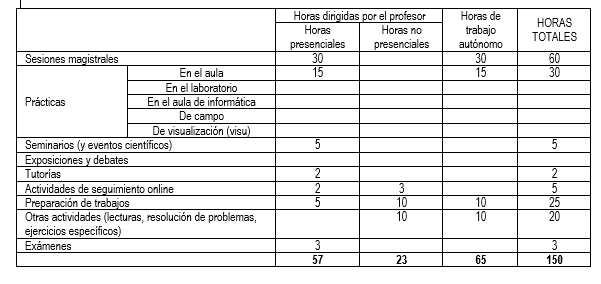
8. Anticipated distribution of the use of the different teaching methods
9. Resources
Reference books.
Aguilar Cobos, J. D. et al. Al-Birka, A1-. Iniciación a la escritura árabe. Almería: Albujayra, 2012.
Aguilar, V. et al. , ¡Alatul! Iniciación a la lengua árabe, Barcelona: Herder, 2011.
Aguilar, V. and Zanón, J. Vocabulario básico árabe-español/español-árabe, Murcia: ICE Universidad, 2004.
Aguilar, V.; Rubio, A. and Domingo, L. Mabruk. Murcia: Diego Marín, 2014.
Brustad, K.; Al-Batal, M. and Al-Tonsi, A. Alif Baa: introduction to Arabic Letters and sounds with website. Washington: Georgetown Univ. Press, 2021.
Wightwick, J. and Gaafar, M. Mastering Arabic 1, Palgrave Macmillan, 3ª ed., 2014.
Other bibliographic references, electronic or other types of resources.
Online dictionaries:
https://www.wordreference.com/es/
https://www.arabdict.com/
Arabic Language Learning websites:
https://learning.aljazeera.net/en
https://www.laits.utexas.edu/aswaat/
10. Assessment
Assessment criteria.
|
Consideraciones Generales |
|
All students are expected to keep up with the exercises and mandatory practices. Participation in class is greatly recommended. |
|
Criterios de evaluación |
|
· Late assignments will not be considered for evaluation, neither for the second exam.
· Passing the exam is mandatory for the continuous assessment grade (exercises and compulsory practical assignments) to be added to the final mark.
|
Evaluation systems.
Evaluation tools will be the same. Additional advice will be offered if requested.
Late assignments will not be considered for evaluation in the second exam (there are no opportunities to re-do all the course assignments, not to deliver late assignments).
Assessment recommendations.
· Daily practice is strongly advised
· Delivering the assignments on the due date makes it easy to pass the course
Recomendaciones para la recuperación
Evaluation tools will be the same. Additional advice will be offered if requested.
Late assignments will not be considered for evaluation in the second exam (there are no opportunities to re-do all the course assignments, not to deliver late assignments).