


Global energy
Estudios Globales / Global Studies
Curso 2026/2027
1. Subject Information
(Date last modified: 29-05-26 11:23)- Code
- 140541
- Plan
- 405
- ECTS
- 6.00
- Type
- Opcional
- Year
- 4
- Duration
- First semester
- Language
- ENGLISH
- Area
- PROSPECCIÓN E INVESTIGACIÓN MINERA
- Departament
- Ingeniería Cartográfica y del Terreno
- Virtual platform
Professor Information
- Professor
- Ignacio Martín Nieto
- Group/s
- Único
- Centre
- E. Politécnica Superior de Ávila
- Office
- 223
- Office hours
- -
- Web address
- https://produccioncientifica.usal.es/investigadores/193135/detalle
- nachomartin@usal.es
- Phone
- 3793
2. Association of the subject matter within the study plan
3. Prerequisites
There are no special requirements for this course, Students should be comfortable reading in English.
4. Learning objectives
- Students will learn about the global energy sector, especially regarding renewable energy.
- Students will be able to analyze the geopolitics involved in the energy supply and transition.
- Students will learn about raw materials related to the energy supply of nations and their future development of the transition towards a progressively more decarbonized energy mix.
- Students will be able to analyze energy needs and environmental issues from a wide and critical perspective.
Students will improve their capacity to develop and defend a balanced standpoint regarding energy and environmental aims and problems
5. Contents
Theory.
1. Introduction to the Global Energy Landscape
1.1. Overview of the Energy Sector: Understanding the current vulnerable state and the shift from fossil fuels to renewables.
1.2. Energy Resources: Types of traditional resources, formation of fossil fuels, and their global location.
1.3. Global Energy Dynamics: Energy transactions, exporters vs. importers, and international relationships.
2. Renewable Energy Technologies and Resources
2.1. Traditional Renewables: Solar, wind, hydraulic, geothermal, and biofuels.
2.2. Emerging Technologies: Marine energy, bladeless wind energy, and albedo exploitation.
2.3. Spatial Distribution: Geographic mapping of renewable potential.
3. The Geopolitics of the Energy Transition
3.1. Strategic Raw Materials: Key minerals and rare earths required for green technology.
3.2. Resource Security: Supply chains, transport routes, and the geopolitics of mineral-rich nations.
3.3. Political Implications: Causes and consequences of the transition on global power structures.
4. Modern Infrastructure and Market Systems
4.1. Transforming the Grid: From centralized to decentralized systems and the rise of the "prosumer".
4.2. Energy Markets: Electricity grids, market bidding, and regional energy possibilities.
4.3. Storage and New Fuels: Battery technologies, hydrogen, and carbon capture strategies.
5. Risks, Security, and Sustainability in a Post-Transition World
5.1. Emerging Risks: Cybersecurity in energy grids and potential conflicts arising from new dependencies.
5.2. Sustainable Consumption: Energy efficiency in buildings, agriculture, and transport.
5.3. Global Public Policy: Developing and defending balanced standpoints on energy and environmental challenges.
6. Competences acquired
Basic / General.
K.1 Apply strategic thinking, identifying goals and designing multi-dimensional action plans to achieve them.
K.2 Plan, evaluate and monitor various solutions that are useful for the development of public policy.
K.3 Identify and link the necessary and/or available information to the objectives and missions set out in projects aimed at resolving global public issues.
K.4 Approach problem-solving in a systemic manner, identifying the various elements and their interactions, as well as their relationship with the wider context.
K.5 Coordinate, design, implement and monitor the execution of projects that incorporate innovative strategies for resolving global public issues.
K6. Integrating multidisciplinary and interprofessional approaches and strategies to tackle complex global issues.
K7. Identifying the root causes of global problems from a thematic and geographical perspective, and their relationship with the political, legal, economic and social context.
K15. Communicate information, ideas and solutions to both specialist and non-specialist audiences.
K16. Present proposals, analyses and findings accurately and professionally in written, oral and visual formats.
Specific.
C11. Understand the global challenges and threats to the stability of national, regional and global economic, political and social systems.
C12. Understand the global challenges and threats that jeopardise peace and security, human rights and justice, the environment and sustainable production, and equality, amongst others.
C13. Identify and describe the causes and development of situations of poverty and inequality around the world
Transversal.
H1. Identify new sources of information and make use of existing sources.
H2. Process, interpret, describe and make use of categorical, ordinal or interval numerical data and the scientific concepts associated with them.
H3. Collect, interpret and make use of qualitative data in the social sciences to analyse problems relating to their field of specialisation.
H7. Produce reports, projects and comprehensive multidisciplinary action strategies.
H10. Engage in continuous, independent learning in the subjects under study.
H11. Work as part of a team, demonstrating responsibility and a commitment to the practical application of acquired knowledge in different roles.
H12. Complete tasks within time and resource constraints.
H16. Identify processes of change and continuity.
H24. Apply economic principles to the assessment and management of natural resources.
7. Teaching methods
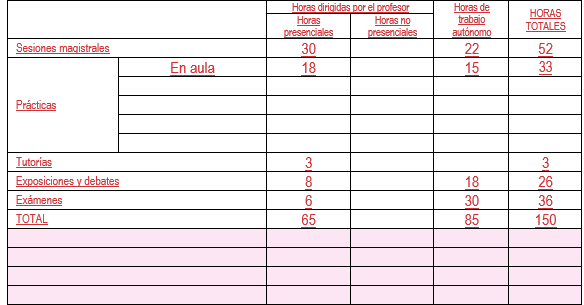
1. Lecture. 2. Case study sessions designed to encourage discussion and critical engagement from students. 3.- Preparation and presentation of assignments designed to highlight the relevance of the subject to other disciplines. 4.- Appropriate use of ICT, communication and information regarding the subject, searching for information online, etc. 5.- Tutorials for student consultation and progress monitoring. 6.- Conducting examinations.
8. Anticipated distribution of the use of the different teaching methods
9. Resources
Reference books.
Tietenberg, T., & Lewis, L. (2018). Environmental and Natural Resource Economics.
Yergin, D. (2020). The New Map: Energy, Climate, and the Clash of Nations.
Van de Graaf, T., & Sovacool, B. K. (2020). Global Energy Politics
Other bibliographic references, electronic or other types of resources.
IRENA (International Renewable Energy Agency): Especially its working papers on innovation and the "REmap" analysis.
IEA (International Energy Agency): For statistics and reports on the global energy market.
European Commission: Strategic documents such as the 2020 Circular Economy Action Plan and the Hydrogen Strategy for a Climate-Neutral Europe
10. Assessment
Assessment criteria.
-
Consideraciones Generales
The assessment procedures measure the extent to which the course objectives have been met and the skills described have been acquired. Consequently, the assessment process will be carried out, on the one hand, by taking into account the work completed by the student during the term—including the completion of exercise sheets, practical work, presentations of assignments and set exercises—and, on the other hand, by evaluating the results achieved in the examinations taken during this period.
Criterios de evaluación
- Demonstrate that they have acquired and understood the main concepts of the course.
- Solve problems by applying theoretical knowledge and drawing on practical results and real-world data.
- Present a prepared problem clearly and with critical rigour.
- Analyse a given situation critically and rigorously.
- Participate actively in problem-solving in class.
Evaluation systems.
Continuous evaluation (30 % of the final mark):
Participation (10%)
Research work (20%)
Exam (70% of the final mark)
Assessment recommendations.
Students are expected to study the subject matter throughout the course, paying particular attention to the materials provided by the teaching staff in both their lectures and practical sessions. Completing exercises, preparing and presenting assignments, and undertaking the practical work set are considered essential for understanding the course content and performing well in the assessment tests
Recomendaciones para la recuperación
The way the course is structured, together with the monitoring and assessment techniques employed, enables us to provide personalised support in this regard whenever difficulties are identified and/or a student requests it. In this way, where a student requires it, suggestions for corrections and improvements to their work and their approach to it will be offered throughout the term