


Basic Russian
Estudios Globales / Global Studies
Curso 2026/2027
1. Subject Information
(Date last modified: 29-05-26 11:41)- Code
- 140547
- Plan
- 405
- ECTS
- 6.00
- Type
- Opcional
- Year
- 4
- Duration
- First semester
- Language
- ENGLISH
- Area
- FILOLOGÍA ESLAVA
- Departament
- Filología Moderna
- Virtual platform
Professor Information
- Profesor/a
- Pedro Antonio Sánchez Encinas
- Group/s
- sin nombre
- Centre
- Fac. Filología
- Office
- Hospedería de Anaya, 1ª planta
- Office hours
- Friday 17:00–19:00
- Web address
- -
- tilllindemann96@usal.es
- Phone
- 923294445 (ext.1794)
2. Association of the subject matter within the study plan
3. Prerequisites
Strong interest in the Russian language and the cultural environment of the “Russian World”.
4. Learning objectives
Introduction to the elementary linguistic foundations of the Russian language from a communicative
perspective, enabling a better understanding of Russia’s role as an international political actor.
GENERAL OBJECTIVES
Acquire the ability or capacity to:
- Develop and use strategies that make it possible to attempt to resolve communication situations in very familiar contexts.
- Make use of previous experiences and knowledge, both linguistic and sociocultural, as a basis for building the learning of the new language.
- Adopt an open attitude toward new elements or situations characteristic of the Russian language and culture.
- Use basic linguistic skills to satisfy the most essential needs of everyday life.
- Participate in short communication situations with reasonable ease and in a simple manner.
- Write short and simple texts about oneself and other people, as well as about everyday topics, following the conventions and formats appropriate to each type of text.
SPECIFIC OBJECTIVES
- Ask for information about a word or expression that is unknown or has been forgotten; indicate understanding or lack of understanding of an utterance; spell or ask for the spelling of a word; repeat or ask for repetition; ask someone to speak more slowly, more loudly, or more softly.
- Greet and respond to greetings; introduce oneself and others; say goodbye; invite; accept or reject an invitation; attract attention; apologize.
- Request information about people, places, or things; about activities, facts, or events; and describe people’s characteristics, feelings, etc.
- Affirm or deny; identify oneself; agree or disagree; express an opinion, agreement, or disagreement; invite, accept, or decline an invitation; respond to an offer; express affection or sympathy, approval, disapproval, interest, disinterest, surprise, etc.
5. Contents
Theory.
Functional Contents
They respond to communication needs in everyday situations, such as:
- Naming a person or an object
- Answering affirmatively or negatively
- Asking for and giving permission
- Greeting and saying goodbye
- Introducing oneself and introducing another person
- Addressing a person
- Asking where a person or object is located
- Locating a person or object in space
- Expressing assumption and probability
- Expressing belonging and possession
- Expressing mood
- Expressing gratitude
- Apologizing
- Offering and requesting information
- Expressing desire, possibility, and obligation
- Expressing opinions, attitudes, and knowledge
- Expressing likes, wishes, and feelings
- Influencing the interlocutor
- Social interaction
Discursive Contents
- Appropriateness to the communicative situation and task (place, channel, interlocutors, and the relationship between them).
- Textual coherence: logical organization of ideas, selection of appropriate morphosyntactic structures and vocabulary.
- Cohesion: internal organization of oral and written texts.
- Discourse-opening mechanisms (извините, простите; скажите, пожалуйста; Молодой человек! Алло!)
- Discourse development: use of linking elements (а, и, но, поэтому, потому что), temporal sequencing (сначала, потом), personalization (по-моему, я думаю ...)
- Discourse conclusion: use of elements indicating summary/recapitulation/finalization... (Наконец, в конце ...)
Phonetic and Graphemic Contents
- The phonetic system of the Russian language
- Writing: printed and cursive characters
- Rules of transcription and transliteration
Grammatical Contents
Sentence
- Constituent elements and their position. Subject–predicate agreement.
- Types of sentences: affirmative and negative declarative (total and partial); interrogative; exclamatory.
- Coordinated clauses: copulative (и, тоже); adversative (а, но).
- Subordinate clauses. Temporal: когда; causal: потому что; explanatory/direct object clauses: что, где, когда.
-
Nouns
- Common and proper nouns.
- Gender and number: basic notions. Most common irregular plurals.
- Case: basic notions. Singular declension in all cases.
- Most frequent uses of cases with/without prepositions (locative with в/на, possessive genitive, directional accusative).
- Nouns that exist only in singular or plural form.
-
Adjectives
- Gender and number of adjectives.
- Singular declension (hard, soft, and mixed) in all cases.
- Long and short forms.
- Agreement of adjectives with nouns in gender, number, and case.
-
Numerals
- Cardinal and ordinal numbers from 1 to 100.
-
Pronouns
- Personal pronouns and their declension.
- Demonstratives (этот / тот): gender, number, and case. Use: identification of objects and people.
- Possessives: gender, number, and case. Use: indicating possession.
- Interrogative / exclamatory pronouns.
-
Verbs
- Conjugation: general rules and specific cases. Consonant alternation.
- Formation of present, past, simple future, and compound future tenses.
- Aspect: basic notions, meaning, and most frequent uses.
- The verb быть and its main functions.
- Formation of the imperative.
- Reflexive verbs and their use.
- Verbs of motion: basic notions. Most common unidirectional verbs (идти, ехать) and their use; multidirectional verbs (ходить, ездить) and their use.
-
Adverbs
- Types: adverbs of place, time, quality, manner, quantity, and purpose.
- Formation of the most common adverbs.
-
Connectors
- Main connectors: и, а, но, тоже, потому что, что, где, когда, который.
-
Lexical Contents
- Personal information
- Russian names
- Greetings and farewells
- Family and kinship
- Professions
- Places of work and study
- Business cards
- States of mind / moods
- In the classroom
- Countries, nationalities, and languages
- Actions
- In the language class
- Colors
- The city
- Days of the week
- Months
- Time / hours
-
Sociocultural Contents
- Everyday life: schedules, eating habits, holidays, leisure activities.
- Living conditions: the house, layout of rooms, decoration...
- Interpersonal relationships: family structure and kinship relations, conversation, introductions.
- Values and beliefs: nationalities (within the country / language / nationality in other countries).
- Body language: identification and understanding of certain characteristic gestures and postures.
- Selection and use of greetings for welcoming, introducing, and saying goodbye.
- Use of informal forms of address. Introduction to formal forms of address
6. Competences acquired
Basic / General.
CG1. To acquire a basic knowledge and appreciation of the Russian language. To develop critical thinking skills through reading and analysis.
CG2. To achieve an introductory level of oral and written communication in the Russian language. To develop the ability to use information sources related to the Russian language (bibliographic resources, databases, Internet sites, etc.). To acquire adequate skills in managing information about the Russian language obtained from various sources.
Specific.
CE1. Cognitive Competencies (knowledge): introductory knowledge of the Russian language; elementary knowledge of Russian grammar; elementary knowledge of terminology and neology in the Russian language; knowledge of the sociolinguistic situation of the Russian language.
CE2. Procedural / Instrumental Competencies (know-how): ability to communicate orally and in writing at an introductory level in the Russian language.
CE3. Academic Competencies: ability to receive, understand, and convey introductory oral and written texts in the Russian language; ability to interrelate acquired knowledge with other languages learned.
CE4. Attitudinal Competencies (personal development): ability to develop a spirit of teamwork; receptive, critical, and respectful openness toward different approaches and viewpoints; ability to enjoy the acquisition of knowledge, well-done work, and rewarded effort.
Transversal.
CT1. Develop analytical and synthesis skills.
CT2. Develop the ability to apply knowledge in practice.
CT3. Evaluate, interpret, and synthesize data and information.
CT4. Develop critical and self-critical reasoning skills.
CT5. Work independently.
CT6. Work in teams and in international groups.
CT7. Develop creativity.
CT8. Appreciate cultural diversity.
7. Teaching methods
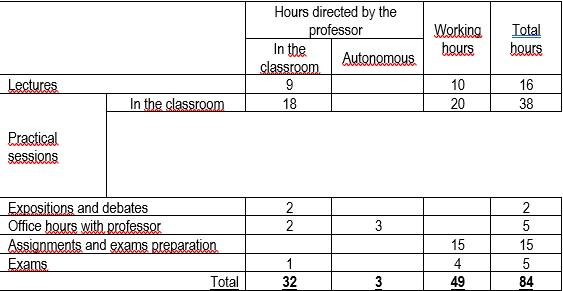
Total workload: 75 hours
Activities in the classroom: 40%
- Theoretical classes
- Practical classes
- Individual tutorials
- Written and oral examination
- Scheduled tutorials
Attendance and active participation in class are essential.
Autonomous activities: 60%
- Preparation of grammar exercises, essays, dialogues, etc.
- Work on theoretical classes and exam preparation
- Exam preparation
- Study of topics explained in class
Learning a language requires constant work on the part of the student.
8. Anticipated distribution of the use of the different teaching methods
9. Resources
Reference books.
GARCÍA ALBERO, R., MANRESA RODRÍGUEZ, M.T., ULIANOVA IRAZU, I. (1997): Paso a paso I. Шаг за шагом I. Madrid: Rubiños – 1860, S. A.
LÓPEZ BERMEJO, A., LÓPEZ BERMEJO, P. (2005): Primeros trazos de caligrafía rusa. Ed.: Brosquil, Valencia
DROSDOV DÍEZ, T., VELASCO MENÉNDEZ, J. (2017): Gramática abreviada de la lengua rusa. Editorial: Cooperación Editorial. Serie: Lux, Madrid
Other bibliographic references, electronic or other types of resources.
Aprender ruso paso a paso: https://learnrussianstepbystep.com/es/inicio/ (Cursos de gramática y vocabulario ruso para principiantes)
Время говорить по-русски: http://www.speak-russian.cie.ru/time_new/esp/course/
Cursos de ruso eficaces online: https://www.busuu.com/es/a/a/aprender-ruso-online
10. Assessment
Assessment criteria.
Evaluation will consist of the following procedures:
- Written examination (including a listening comprehension test): 75%
- Individual exercises and assignment submissions: 15%
- Attitude (class attendance, active participation in classroom activities, use of resources): 10%
|
General Considerations |
|
As continuous assessment is applied, it is important that students attend each class session with a participatory attitude, maintain consistent dedication, complete the preparatory tasks for each session, and carry out the exercises assigned for the following session. Knowledge and skills are cumulative and progressive in nature; therefore, it is essential to maintain disciplined study habits in order to achieve the desired assessment results. |
|
Evaluation Criteria |
|
Written examination (including a listening comprehension test): 75% Individual exercises and assignment submissions: 15% Attitude (class attendance, active participation in classroom activities, use of resources): 10% |
Evaluation systems.
Written examination: written comprehension and expression, grammar, vocabulary and translation, as well as listening comprehension, will be assessed.
Exercises and assignments: completion of classroom tasks, submission of assignments, and active participation in class.
Attitude: attendance record and monitoring of the student’s performance in class
Assessment recommendations.
Consistent work and class attendance
|
Recommendations for Resist Exam |
|
Consistent work and class attendance. |