


Global environmental Challenges
Estudios Globales / Global Studies
Curso 2026/2027
1. Subject Information
(Date last modified: 25-05-26 14:09)- Code
- 140538
- Plan
- 405
- ECTS
- 3.00
- Type
- Year
- 4
- Duration
- Language
- ENGLISH
- Area
- -
- Departament
- Economía Aplicada
- Virtual platform
Professor Information
- Profesor/a
- Luis Garrido Mateos
- Group/s
- sin nombre
- Centre
- Fac. Economía y Empresa
- Office
- 113 de la Facultad de Derecho
- Office hours
- By appointment
- Web address
- https://derecho.usal.es/staff/garrido-mateos-luis/
- luisgarrimateos@usal.es
- Phone
- -
2. Association of the subject matter within the study plan
3. Prerequisites
No specific previous skills are required
4. Learning objectives
The students will enhance their knowledge, analysis capacity and critical view about the following:
1. Environmental degradation as an example of market failure and its impact on equity.
2. Main local, regional, and global environmental challenges, as well as their geopolitical and socioeconomic impacts.
3. Case studies on the use of efficient, scale, cost-effective and natural-capital-based instruments.
4. International treaties and agreements to deal with common environmental challenges.
5. Contents
Theory.
- Principles of environmental economics.
- Environmental policy design.
- Environmental challenges:
- Climate change.
- Water distribution.
- Biodiversity loss.
- Energy transition.
- Demography and the environment.
- Sustainable urbanism and mobility.
- Corporate impacts and dependencies on nature.
- Natural resources management.
6. Competences acquired
Basic / General.
As stated in the official supporting documents for the degree in Global Studies
Specific.
As stated in the official supporting documents for the degree in Global Studies
Transversal.
As stated in the official supporting documents for the degree in Global Studies
7. Teaching methods
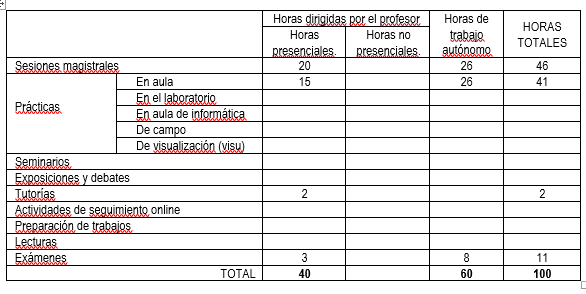
The teaching methodology will be based on lectures, guided readings, and debates on students’ presentations
8. Anticipated distribution of the use of the different teaching methods
9. Resources
Reference books.
Main books:
- The CORE Team. (2017). The Economy: Economics for a Changing World. CORE Econ. https://www.core-econ.org
- The CORE Econ Team. (2023). The Economy 2.0: Microeconomics. CORE Econ. https://core-econ.org/the-economy/
- The CORE Econ Team. (2025). The Economy 2.0: Macroeconomics. CORE Econ. https://core-econ.org/the-economy/
- The CORE Team. (s.f.). Economy, Society, and Public Policy. CORE Econ. https://www.core-econ.org/espp/
Additional books:
- Buchholz, W. (2019): Foundations of Environmental Economics, Springer.
- Hanley, N (2007): Environmental economics in theory and practice, Palgrave
- Tietenberg, T. (2009): Environmental economics and policy, Pearson.
Other bibliographic references, electronic or other types of resources.
- CORE-ECON project (https://www.core-econ.org/)
- European Commission – Environment (https://ec.europa.eu/environment/index_en.htm)
- IPBES (https://ipbes.net/)
- IPCC (https://www.ipcc.ch/)
- Stockholm Resilience Center (https://www.stockholmresilience.org/)
- Sustainable Development Goals (https://sustainabledevelopment.un.org/)
- TEEB (http://www.teebweb.org/)
- UN Environment Programme (https://www.unenvironment.org/)
10. Assessment
Assessment criteria.
|
Consideraciones Generales |
|
The aim is not to make the student memorize the materials, but to let them understand the rationale behind them and apply the acquired skills and knowledge to the analysis of different environmental issues. |
|
Criterios de evaluación |
|
Acquisition and internalization of the general and specific skills of the course, applied to the set of contents of the course. The evaluation will focus on the understanding of the rationale behind environmental problems and their solution proposals, the deepness in the search and analysis of data and argumentations in related documents and web pages, and the ability to apply this all to different contexts and situations. |
Evaluation systems.
|
Instrumentos de evaluación |
|
The grade will be based on a final exam complemented with, if the circumstances permit, information on the student’s ongoing evaluation (assignments and presentations). |
Assessment recommendations.
|
Recomendaciones para la evaluación. |
|
Given the comprehensive approach of the course, a strictly continuous work by the student is highly recommended. |