


Intercultural Communication, Negotiation, and Conflict
Estudios Globales / Global Studies
Curso 2026/2027
1. Subject Information
(Date last modified: 28-05-26 13:03)- Code
- 140548
- Plan
- 405
- ECTS
- 6.00
- Type
- Opcional
- Year
- 4
- Duration
- First semester
- Language
- ENGLISH
- Area
- -
- Departament
- Psicología Social y Antropología
- Virtual platform
Professor Information
2. Association of the subject matter within the study plan
3. Prerequisites
Basic knowledge of psychosocial processes
4. Learning objectives
By the end of this course, students will be able to:
- Analyze complex cultural dynamics using foundational communication frameworks.
- Design and implement negotiation strategies tailored to diverse multicultural environments.
- Mediate and resolve international disputes by minimizing the impact of cultural clashes.
Specific Learning Objectives by Module
Module 1: Intercultural Communication & Theory
Identify and deconstruct personal cognitive biases, stereotypes, and ethnocentric assumptions.
Map social and corporate behaviors using the cultural dimensions of Hofstede and Hall.
Evaluate individual Intercultural Communicative Competence (ICC) using validated theoretical models.
Module 2: Cross-Cultural Negotiation
Differentiate between varied negotiation styles (e.g., linear-active vs. reactive) and adapt proposals to the counterpart's profile.
Interpret non-verbal communication signals (silence, proxemics, gestures) accurately during bilateral meetings.
Apply face-saving techniques to build sustainable, long-term global business agreements.
Module 3: Conflict Resolution & Cultural Differences
Diagnose the root causes of friction in multicultural teams, distinguishing between value clashes and operational issues.
Select the most effective conflict management style based on Ting-Toomey’s Face-Negotiation Theory.
Execute the role of a neutral mediator by leveraging Cultural Intelligence (CQ) to guide parties toward mutual agreement.
5. Contents
Theory.
Module 1. Intercultural Communication & Theory.
This initial module establishes the foundational theoretical frameworks and self-assessment tools needed before entering direct cross-cultural interactions
- 1. Foundations of Cultural Identity and Perception
Key Concepts: Essentialism vs. Non-essentialism; The "Cultural Iceberg" model; Cognitive biases and ethnocentrism.
- 2. Global Theoretical Frameworks and Cultural Dimensions
Key Concepts: Geert Hofstede’s Cultural Dimensions (Individualism vs. Collectivism, Power Distance); Edward T. Hall’s High vs. Low Context cultures.
- 3 Intercultural Communicative Competence (ICC)
Key Concepts: Darla Deardorff’s ICC Model (attitudes, knowledge, and skills); Cultural adaptation strategies and overcoming Culture Shock.
Module 2. Cross-Cultural Negotiation
This module applies communication theories directly to international business, global diplomacy, and international deal-making.
2.1. Negotiation Styles and Behavioral Patterns
Key Concepts: Linear-active vs. Reactive styles; Time orientation (monochronic vs. polychronic); Relationship-oriented vs. Task-oriented negotiation.
2.2. Non-Verbal Communication and International Protocol
Key Concepts: Proxemics (space), Kinesics (gestures), and Haptics (touch); The strategic use and meaning of silence in global boardroom meetings.
2.3. Cross-Cultural Value Creation Strategies
Key Concepts: Adapting the Harvard Negotiation Project (mutual gains) to multicultural environments; The concept of "Saving Face" in international trade.
Module 3. Conflict Resolution & Cultural Differences
This final module addresses friction, misunderstandings, and disputes that emerge when cross-cultural communication or negotiation breaks down.
3.1. Typologies and Sources of Intercultural Conflict
Key Concepts: Affective, interest-based, cognitive, and value conflicts; Clashes stemming from divergent behavioral norms and expectations.
3.2. Conflict Management Styles and Face-Negotiation Theory
Key Concepts: Stella Ting-Toomey’s Face-Negotiation framework; Conflict resolution styles (Integrating, Obliging, Dominating, Avoiding, Compromising) across cultures.
3.3. Intercultural Mediation and Third-Party Intervention
Key Concepts: The role of a neutral mediator in multicultural contexts; Leveraging Cultural Intelligence (CQ) for peaceful international dispute resolution.
6. Competences acquired
Basic / General.
C6, C12, C14, C16, C17, C18
7. Teaching methods
Teaching methodologies (examples)
1. Interactive Lectures
- Description: Short, engaging presentations used to introduce core theoretical frameworks (such as Hofstede's dimensions or Face-Negotiation theory).
- Focus: These sessions are dynamic, embedding open debates, thought-provoking questions, and quick dilemma-solving exercises to maintain high student engagement.
2. Case Study Method
- Description: Detailed analysis of real-world success and failure stories in international settings (e.g., cross-border corporate mergers failed by cultural clashes or diplomatic standoffs).
- Focus: Students diagnose the root causes of the problem from a multicultural perspective and propose strategic, evidence-based solutions using the course bibliography.
3. Simulations and Role-Playing Exercises
- Description: Practical immersion where students are randomly assigned specific cultural identities, communication styles, or hierarchical roles.
- Focus: Recreating bilateral negotiation tables or workplace disputes within multicultural teams allows students to experience firsthand the frustration of misunderstandings and the satisfaction of reaching an agreement.
4. Critical Incidents Analysis
- Description: Presentation of brief narratives, vignettes, or video clips depicting an ambiguous intercultural misunderstanding that disrupts a business or professional relationship.
- Focus: Acting as "cultural detectives," students deconstruct the scenario to identify which invisible cultural norm was violated and rewrite the interaction for a successful outcome.
5. Cooperative Learning & Structured Debates
- Description: Working in diverse teams to solve specific project briefs or defending opposing views on complex global ethical dilemmas.
- Focus: This directly tests and builds the students' own intercultural communicative competence by forcing them to negotiate and resolve their internal team conflicts.
Examples of practical exercises for each module:
-
- Classroom Activity: Cultural Self-Mapping. Students analyze and chart their own unconscious cultural biases and cultural heritage
- Classroom Activity: Global Analysis. Students review how a multinational brand adapts its advertising campaigns based on a target country's cultural context.
-
- Classroom Activity: Bilateral Negotiation Simulation. A role-play exercise where a polychronic/collectivist team negotiates a contract with a monochronic/individualist team.
- Classroom Activity: The Protocol Lab. Case studies tracking real-world corporate errors (gaffes) caused by misinterpreting physical gestures.
-
- Classroom Activity: Critical Incident Deconstruction. Students analyze a real-world dispute within an international organization (e.g., the UN or a multinational firm) to locate its cultural roots.
- Classroom Activity: Dispute Resolution Role-Play. Simulating a workplace performance review conflict between a manager and an employee with different hierarchical expectations.
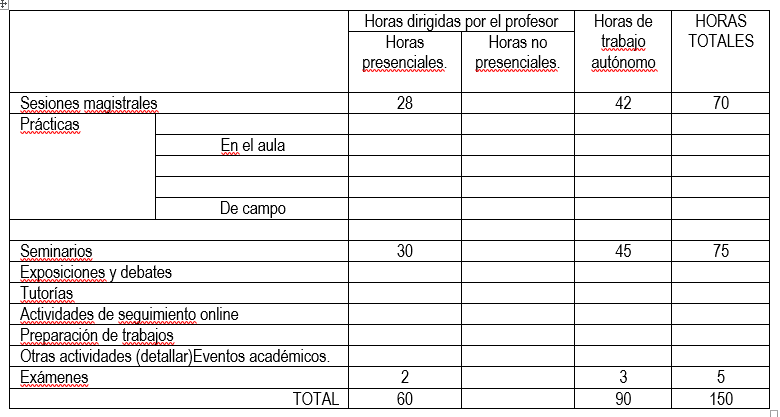
8. Anticipated distribution of the use of the different teaching methods
9. Resources
Reference books.
- Adair, W. L., & Elashmawi, F. (Eds.). (2022). The Palgrave handbook of cross-cultural business negotiation. Palgrave Macmillan.
- Avila Marcué, F. (2011). Tácticas para la negociación internacional: Las diferencias culturales. Trillas
- Ghauri, P. N., & Usunier, J. C. (Eds.). (2003). International business negotiations (2nd ed.). Pergamon.
- Holliday, A. (2018). Understanding intercultural communication: Negotiating a grammar of culture (2nd ed.). Routledge.
- Jackson, J. (Ed.). (2020). The SAGE handbook of intercultural communication (2nd ed.). SAGE Publications.
- Katulic, G., Ramos, M., & Ortiz, S. (2018). Intercultural mediation and conflict management training: A practitioner's guide. Academic Press.
- Martin, J. N., & Nakayama, T. K. (2021). Intercultural communication in contexts (8th ed.). McGraw-Hill Education.
- Rodrigo Alsina, M. (1999). La comunicación intercultural. Anthropos Editorial.
- Thomas, D. C., & Inkson, K. (2017). Cultural intelligence: Living and working globally (3rd ed.). Berrett-Koehler Publishers
- Ting-Toomey, S. (2012). Understanding intercultural conflict competence: Multiple theoretical insights. In J. Jackson (Ed.), The Routledge handbook of language and intercultural communication (pp. 279-293). Routledge.
Other bibliographic references, electronic or other types of resources.
Specific referencees for each block
1. Intercultural Communication & Theory
- The SAGE Handbook of Intercultural Communication (J. Jackson): A comprehensive, global volume covering foundational theories and modern practices in intercultural dynamics.
- Understanding Intercultural Communication: Negotiating a Grammar of Culture (A. Holliday): Ideal for understanding how cultural identities are shaped and negotiated in daily life.
- Intercultural Communication in Contexts (J. N. Martin & T. K. Nakayama): A widely used university textbook exploring intercultural communication through multiple theoretical lenses.
2. Cross-Cultural Negotiation
- The Palgrave Handbook of Cross-Cultural Business Negotiation (W. L. Adair & F. Elashmawi): A foundational resource analyzing international negotiation strategies, styles, and deal-making.
- International Business Negotiation (P. N. Ghauri & J. C. Usunier): Focuses on the impact of cultural diversity, timing, and behavior during global trade and corporate negotiations.
3. Conflict Resolution & Cultural Differences
- Communicating, Negotiating, and Resolving Conflicts Across Cultures (D. C. Thomas & K. Inkson): Directly aligns with this syllabus by showing how to build cultural intelligence to resolve clashes.
- Understanding Intercultural Conflict Competence (S. Ting-Toomey): Essential reading on "face-negotiation theory" and how different cultures handle, avoid, or resolve confrontation.
- Intercultural Mediation and Conflict Management Training (G. Katulic et al.): A practical guide for professional mediation, handling disputes, and training in multicultural environments.
10. Assessment
Assessment criteria.
|
Consideraciones Generales |
|
The final grade consists of two complementary parts, assessing both the acquisition of theoretical knowledge and the practical application of the content through the work developed throughout the course.
|
|
Criterios de evaluación |
|
Theoretical content: 70%, evaluated through a multiple-choice exam. Practical content: 30%, evaluated through a practice notebook (portfolio)
|
Evaluation systems.
|
Instrumentos de evaluación |
|
Multiple-choice exam on the theoretical content covered: 70%. Practice notebook (portfolio) containing the activities carried out in seminars and practical sessions: 30%. |
Assessment recommendations.
|
Recomendaciones para la evaluación. |
|
Continuous study of the material taught throughout the course is highly recommended—both in lectures and in seminars or practical classes—alongside active participation in all scheduled activities. |
|
Recomendaciones para la recuperación. |
|
In the extraordinary examination call (convocatoria extraordinaria), students may reset exclusively the part or parts they failed to pass during the ordinary examination call (convocatoria ordinaria). The original weights for the final grade will be maintained (70% multiple-choice exam / 30% practice notebook). The grades obtained for the parts already passed in the ordinary call will be preserved.
|