


DECISION MAKING
Estudios Globales / Global Studies
Curso 2026/2027
1. Subject Information
(Date last modified: 29-05-26 11:18)- Code
- 140528
- Plan
- 405
- ECTS
- 6.00
- Type
- Compulsory
- Year
- 4
- Duration
- First semester
- Language
- ENGLISH
- Area
- CIENCIA POLÍTICA Y DE LA ADMINISTRACIÓN
- Departament
- Derecho Público General
- Virtual platform
Professor Information
- Profesor/a
- Guillermo Enrique Boscán Carrasquero
- Group/s
- sin nombre
- Centre
- -
- Office
- -
- Office hours
- Under request by email
- Web address
- -
- Phone
- -
- Profesor/a
- Karen Arlin Rivas
- Group/s
- sin nombre
- Centre
- Fac. Derecho
- Office
- Planta Jardín
- Office hours
- Under request by email
- Web address
- -
- arlin.rivas@usal.es
- Phone
- 923 29 44 00
2. Association of the subject matter within the study plan
3. Prerequisites
Students are expected to attend classes and follow the course closely, striving to meet the learning objectives of each unit.
4. Learning objectives
The main objective of this course is to understand and analyze the different decision-making mechanisms at the individual, group, and institutional levels, with a special focus on EU institutions. The course centers on basic models and their applications to understand real-world social, political, and international issues.
5. Contents
Theory.
- Theoretical foundations: Rational Choice and Bounded Rational Choice perspectives.
- Game Theory.
- Groups and decision-making rules in EU institutions.
- Institutional games in the EU: Simulations.
- How to achieve an agreement? Negotiation methods applied to EU scenarios.
6.How do we decide? A glance at EU elections and their impact on the institutions.
6. Competences acquired
Basic / General.
CB2. That students know how to apply their knowledge to their work or vocation in a professional way and possess the skills that are often demonstrated through the development and defense of arguments and problem solving within your area of study.
CB3. Students have the ability to gather and interpret relevant data normally within their area of study of to make judgments that include a reflection on relevant social, scientific, or ethical issues.
CB4. To enable students to convey information, ideas, problems, and solutions to a specialized audience as
unskilled.
CB5. Students have developed those learning skills necessary to undertake studies with a high degree of autonomy.
CG1 - Apply the knowledge acquired to solve specific problems in new or unfamiliar environments within of broader (or multidisciplinary) contexts.
CG3 - Develop organizational, task planning and project coordination skills that facilitate teamwork.
CG4 - Develop skills to design and implement practical problem-solving plans and programs with a global or multidisciplinary approach.
Specific.
CE13 - Know and understand the different mechanisms of decision making and problem solving in the EU and international context.
Transversal.
Ability to reflect on theoretical issues.
Ability to analyse empirical information.
Ability to link empirical analyses and theoretical issues
7. Teaching methods
To ensure the acquisition of each theoretical aspect listed, each topic is supported by a practical activity that includes planning, conducting, and analyzing experiments or simulations on decision-making processes within different EU institutions. Students are also required to write a final paper in which they must apply the knowledge acquired to the study of a real decision-making case within an EU institution.
8. Anticipated distribution of the use of the different teaching methods
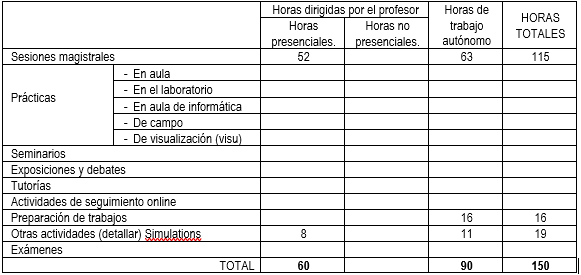
9. Resources
Reference books.
|
Binmore, K. Game Theory, a Very Short Introduction Oxford University Press, 2007. Bueno de Mesquita, B. Principles of International Politics (5th ed.) CQ Press, 2013. Chankong, V., & Haimes, Y. Y. (2008). Multiobjective decision making: theory and methodology. Courier Dover Publications. Coleman, J. S., & Fararo, T. J. (1992). Rational choice theory. Nueva York: Sage. Cox, G. W. (1999). The empirical content of rational choice theory: A reply to Green and Shapiro. Journal of Theoretical Politics, 11(2), 147-169. De Martino, B., Kumaran, D., Seymour, B., & Dolan, R. J. (2006). Frames, biases, and rational decision-making in the human brain. Science, 313(5787), 684-687. Doyle, J. (1999). Rational decision making. MIT encyclopedia of the cognitive sciences, 701-703. Edwards, W. (1954). The theory of decision making. Psychological bulletin, 51(4), 380. Ferejohn, J., & Satz, D. (1996). Unification, universalism, and rational choice theory. The Rational Choice Controversy, 71-84. Fiorina, M. P., & Putterman, L. (1996). Rational choice, empirical contributions, and the scientific enterprise (pp. 85-94). Yale University Press. Forsyth, T., & Johnson, C. (2014). Elinor Ostrom's legacy: governing the commons, and the rational choice controversy. Development and Change, 45(5), 1093-1110. Friedman, J. (Ed.). (1996). The rational choice controversy: Economic models of politics reconsidered. Yale University Press. Friedman, J. (Ed.). (1996). The rational choice controversy: Economic models of politics reconsidered. Yale University Press. Hernández, A. (2020). La lógica y el arte de decidir. Aprende a tomar decisiones correctas. Almuzara, Madrid. Green, D., & Shapiro, I. (1994). Pathologies of rational choice theory: A critique of applications in political science. Yale University Press. Green, D., & Shapiro, I. (2009). Revisiting the pathologies of rational choice. In The flight from reality in the human sciences (pp. 51-99). Princeton University Press. Kahneman, D,Thinking Fast and Slow, Farrar and Strauss, 2013 Keohane, R. O. (2002). Rational choice theory and international law: Insights and limitations. The Journal of Legal Studies, 31(S1), S307-S319. Kochenderfer, M. J. (2015). Decision making under uncertainty: theory and application. MIT press. Koechlin, E. (2020). Human Decision-Making beyond the rational decision theory. Trends in cognitive sciences, 24(1), 4-6. Morrow, J. D. (1994). Game theory for political scientists. Princeton University Press. Scott, J. (2000). Rational choice theory. Understanding contemporary society: Theories of the present, 129, 671-85. Shafir, E., Tversky, A., Smith, E. E., & Osherson, E. E. D. (2002). Decision making. Foundations of Cognitive Psychology: Core Readings, 601-620. Shespsle, K. Analyzing Politics: Rationality, Behavior and Instititutions (2nd ed.) Norton, 2010. Simon, H. A. (1979). Rational decision making in business organizations. The American economic review, 69(4), 493-513. Stevenson, M. K., Busemeyer, J. R., & Naylor, J. C. (1990). Judgment and decision-making theory. Walt, S. M. (1999). Rigor or rigor mortis? Rational choice and security studies. International security, 23(4), 5-48. Weingast, B. R. (1996). Political institutions: Rational choice perspectives. A new handbook of political science, 167, 168. |
Other bibliographic references, electronic or other types of resources.
Avalilable at the Studium platform
10. Assessment
Assessment criteria.
|
Consideraciones Generales |
|
The evaluation aims to assess students' progress throughout the entire semester. The curriculum is progressive, ranging from the simplest to the most complex topics. |
|
Criterios de evaluación |
|
Evaluation systems.
- Planning and conducting an experiment/simulation on the decision-making process of an EU institution.
- Writing various essays to analyze the results of the different experiments/simulations.
Completing a final paper in which students apply the acquired theoretical knowledge to analyze a real-case decision-making process within an EU institution.
Assessment recommendations.
|
Attend classes and follow the course closely, aiming to achieve the objectives of each unit. |
|
Recomendaciones para la recuperación. |
|
All content will be evaluated in the second examination session. It will consist of a research paper in which students must demonstrate that they have acquired all the course competencies. Grades from previous assignments, such as reports or tests, will not be considered at this stage.
|