


CRIMINAL POLICY
Estudios Globales / Global Studies
Curso 2026/2027
1. Subject Information
(Date last modified: 29-05-26 11:21)- Code
- 140540
- Plan
- 405
- ECTS
- 6.00
- Type
- Opcional
- Year
- 4
- Duration
- First semester
- Language
- ENGLISH
- Area
- DERECHO PENAL
- Departament
- Derecho Público General
- Virtual platform
Professor Information
- Profesor/a
- Miguel Álvarez Hernández
- Group/s
- sin nombre
- Centre
- Fac. Derecho
- Office
- 291
- Office hours
- Under request my email
- Web address
- https://produccioncientifica.usal.es/investigadores/206324/detalle
- miwiah@usal.es
- Phone
- 923 29 44 00 – ext. 6976
2. Association of the subject matter within the study plan
3. Prerequisites
The course has no prerequisites
4. Learning objectives
- Understanding of the meaning and function of Criminal Policy.
- Understanding of the historical evolution of the State and its corresponding criminal policies.
- Understanding and assimilation of the criminal policy foundations of each institution within the criminal justice system.
- Knowledge of the main criminal policy conflicts arising in modern Western societies, as well as the theoretical and practical responses developed by public authorities.
- Critical analysis of social reality and social problems, formulating solutions that respect human rights and the principles of equality and universal accessibility.
- Ability to integrate legal, sociological, and psychological knowledge in order to provide systemic solutions addressing criminal phenomena from a global perspective.
Ability to systematize and argue proposals aimed at preventing crime, delinquency, and victimization.
5. Contents
Theory.
Unit 1. Conceptual Approach to Criminal Policy
Unit 2. Historical Development of Criminal Policy: Evolution of Models of Social Reaction
Unit 3. Contemporary Criminal Policy: From Penal Welfarism to Exclusionary Policies
Unit 4. Actors in Criminal Policy
Unit 5. Criminal Policy in the Protection of Life
Unit 6. Criminal Policy in Response to Domestic and Gender-Based Violence
Unit 7. Criminal Law Protection of Sexual Freedom and Integrity
Unit 8. The Challenge of Transnational Organized Crime
Unit 9. Criminal Policy in Response to Immigration and Human Trafficking
Unit 10. Criminal Policy on Drug-Related Issues
Unit 11. Crime and Power: Criminal Policy in Response to Corruption and White-Collar Crime
Unit 12. Criminal Policy in Response to Terrorism
Unit 13. Cultural Diversity and Criminal Policy
6. Competences acquired
Basic / General.
C11, C12
Specific.
H1, H10, H11, H13, H16, H19,
Transversal.
K1, K2, K4, K10
7. Teaching methods
. Theorical lectures
2. Practical sessions and assignments
3. Participation in seminars, readings, etc
4. Office hours
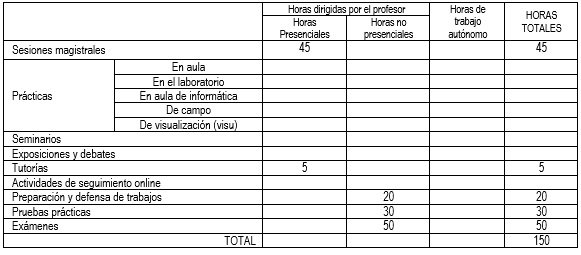
8. Anticipated distribution of the use of the different teaching methods
9. Resources
Reference books.
GARLAND, David (2001). The Culture of Control: Crime and Social Order in Contemporary Society. 1st ed. Oxford University Press.
TONRY, Michael (ed.) (2012). The Oxford Handbook of Crime and Public Policy. 1st ed. Oxford University Press.
TONRY, Michael (ed.) (2011). The Oxford Handbook of Crime and Criminal Justice. 1st ed. Oxford University Press.
SANZ MULAS, Nieves (2025). Política criminal, 6ª edic. Tirant lo Blanch.
Further references will be provided throughout the course,
10. Assessment
Assessment criteria.
|
Assesment criteria |
|
General Considerations Throughout the course, continuous monitoring and assessment of both in-person and non-in-person activities will be carried out. The course combines different assignment tools. Assessment Criteria The final grade will be determined as follows: 50%: Final theoretical exam. In order to pass the course, at least 50% of this exam must be achieved. 40%: Completion of practical assignments by the student. This component will take into account the grades obtained in coursework, as well as other criteria such as class participation, quality of presentations, and resolution of practical cases, among others. 10%: Participation in class.
|
|
Evaluation system |
|
Evaluation systems.
- Participation in class
- Due completion and grading of the different practical assignments
Final exam.
Assessment recommendations.
|
Participation in class is highly recommended. |
|
Recomendaciones para la recuperación. |
|
Evaluation tools will be the same. Additional advice, tailored to each case, will be offered if requested. Only the grade for the final examen may be retaken. Therefore, in this assesment period, the grades obtained in practical assignments and participation during the course will be maintained. |