


THE EUROPEAN UNION AS A GLOBAL ACTOR
Estudios Globales / Global Studies
Curso 2026/2027
1. Subject Information
(Date last modified: 29-05-26 11:26)- Code
- 140543
- Plan
- 405
- ECTS
- 6.00
- Type
- Opcional
- Year
- 4
- Duration
- First semester
- Language
- ENGLISH
- Area
- DERECHO INTERNACIONAL PÚBLICO Y RELACIONES INTERN.
- Departament
- Derecho Público General
- Virtual platform
Professor Information
- Coordinador/a
- Polly Ruth Polak
- Group/s
- sin nombre
- Centre
- Fac. Derecho
- Office
- 225
- Office hours
- Martes y Miércoles 12 a 14
- Web address
- https://produccioncientifica.usal.es/investigadores/157343/detalle
- pollypolak@usal.es
- Phone
- 923294400 Ext. 1673
- Profesor/a
- Daniel González Herrera
- Group/s
- sin nombre
- Centre
- Fac. Derecho
- Office
- 227
- Office hours
- Martes y Miércoles 12 a 14
- Web address
- http://campus.usal.es/~derechointernacionalpublico
- daniglez@usal.es
- Phone
- extensión 1665
- Profesor/a
- M. Eugenia Hernández Peribánez
- Group/s
- sin nombre
- Centre
- Fac. Derecho
- Office
- Seminario de Internacional 225
- Office hours
- Martes y Miércoles de 12 a 14
- Web address
- -
- dpto.dpg@usal.es
- Phone
- 1673
2. Association of the subject matter within the study plan
3. Prerequisites
Those acquired by passing the subjects “International Relations”, “Public International Law” and “European Union” belonging to the first and second courses of the Degree
4. Learning objectives
The aim of this subject is to provide students with a clear and practice-oriented understanding of the European Union’s external action as both a legal framework and a set of policies. It examines the EU’s role as an international actor, its external competences, the conclusion of international agreements, and its participation in international organisations. The course also introduces the main areas of EU external policy, including trade, development cooperation, neighbourhood policy, CFSP, restrictive measures, and CSDP, with particular attention to the major international challenges affecting the Union. Students will develop the capacity to identify the main legal, political, and institutional features of the EU as an international actor, and to analyse how the Union projects its interests and values in the international arena.
5. Contents
Theory.
Part I. The European Union’s External Action: Introduction
Lesson 1: The European Union on the international stage: a general overview. 2.-The relevance and originality of the EU as an actor in international relations. 2.-The structure and basic principles of EU external action. 3.-The competences of the EU in the field of external action.
Lesson 2: The EU’s External Action Legal Framework. 1.-The procedure for the conclusion of international agreements. 2.-Rules arising from external relations within the EU legal order. 3.-The participation of the EU in international organisations
Part II. The External Policies of the European Union
Lesson 2: The Common Commercial Policy. 1.-The relevance of commercial policy within the framework of EU external action. 2.-Main instruments of the Common Commercial Policy. 3.- The EU’s Free Trade Agreements with the rest of the world. 4. The EU’s Development and Cooperation Policy. 5.- The European Neighbourhood Policy (ENP).
Lesson 3: The EU’s Common Foreign and Security Policy (CFSP). 1.-Origins and evolution of the CFSP. 2.-Institutions and decision-making in the field of the CFSP. 3.-The EU’s instruments of action under the CFSP. 4.- The fields of action of the CFSP. 5.-EU restrictive measures.
Lesson 4: The EU’s Common Security and Defense Policy (CSDP). 1.- Origins and evolution of the CSDP. 2.-Institutions, decision-making, and operational structures. 3.-Civilian and military missions and operations. 4.-Defence capabilities and cooperation: PESCO, the European Defence Agency, and the European Defence Fund. 5.- Strategic autonomy, NATO, and the limits of EU defence integration.
6. Competences acquired
Basic / General.
CB2, CB4, CB5, A2 y A3
Specific.
B3, B10, B12 y B13
7. Teaching methods
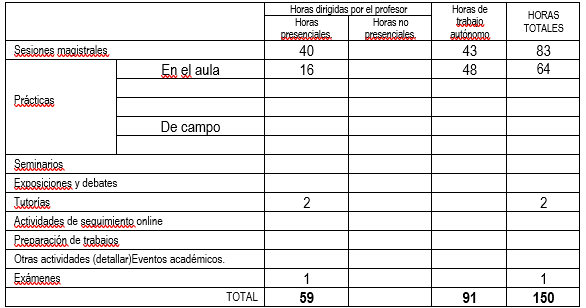
8. Anticipated distribution of the use of the different teaching methods
9. Resources
Reference books.
Wessel, R.A., Larik, J. (Eds.), 2026. EU External Relations Law: Text, Cases and Materials, 3rd ed. Hart Publishing/Bloomsbury, Oxford.
Eeckhout, P.: EU External Relations Law (2ª ed.), Oxford, Oxford University Press, 2012.
Wouters, J., Hoffmeister, F., De Baere, G., Ramopoulos, T. (Eds.), 2021. The Law of EU External Relations: Cases, Materials, and Commentary on the EU as an International Legal Actor, 3rd ed. Oxford University Press, Oxford.
10. Assessment
Assessment criteria.
|
Consideraciones Generales |
|
Active participation in class, following the readings and additional materials is necessary for a good understanding of the classes. Flipped class method would be implemented for some lessons
|
|
Criterios de evaluación |
|
Class participation, seminars and case studies as part of continuous assessment will account for 50% of the final grade. The remaining 50% will be based on a multiple choice question exam held during the ordinary examination period. |
Assessment recommendations.
|
a