


EUROPEAN AND INTERNATIONAL HUMAN RIGHTS PROTECTION
Estudios Globales / Global Studies
Curso 2026/2027
1. Subject Information
(Date last modified: 29-05-26 9:53)- Code
- 140544
- Plan
- 405
- ECTS
- 6.00
- Type
- Opcional
- Year
- 4
- Duration
- First semester
- Language
- ENGLISH
- Area
- DERECHO INTERNACIONAL PÚBLICO Y RELACIONES INTERN.
- Departament
- Derecho Público General
- Virtual platform
Professor Information
- Profesor/a
- Elsa Fernando Gonzalo
- Group/s
- sin nombre
- Centre
- Fac. Derecho
- Office
- 225
- Office hours
- Tuesdays and Wednesdays from 12:00 to 14:00
- Web address
- http://campus.usal.es/~derechointernacionalpublico/
- elsafergon@usal.es
- Phone
- -
- Profesor/a
- M. Eugenia Hernández Peribánez
- Group/s
- sin nombre
- Centre
- Fac. Derecho
- Office
- Seminario de Internacional 225
- Office hours
- Tuesdays and Wednesdays from 12:00 to 14:00
- Web address
- -
- dpto.dpg@usal.es
- Phone
- 1673
2. Association of the subject matter within the study plan
3. Prerequisites
It is recommended to have previously passed courses in Public International Law, European Union law or Basic Principles of Human Rights, or similar subjects in any other national programme distinct from Global Studies.
4. Learning objectives
The course on the international protection of human rights focuses on analyzing the field of international human rights law, a complex and extensive system of international norms designed to set limits on the actions of States in relation to individuals under their jurisdiction and to establish international obligations incumbent upon them.
This course aims to equip students with knowledge of the universal human rights protection system within the framework of the United Nations and the European and Inter-American regional systems. Thus, within the European framework, the work of the Council of Europe is studied, in particular the European Convention on Human Rights, as well as that of the European Union.
Students will also become familiar with the case law of the European Court of Human Rights, the European Court of Justice and the Inter-American Court of Human Rights. With a practical focus, the course aims to equip students with the basic tools to understand and engage in international litigation in the field of human rights.
5. Contents
Theory.
PART ONE: FOUNDATIONS AND HISTORICAL BACKGROUND
LESSON 1. Introductory concepts regarding human rights. - 1. Terminological and conceptual approaches to human rights. - 2. The State’s discretionary power regarding the treatment of its population. 3. The codification of human rights: declarations and revolutions.
LESSON 2. Historical background to the internationalisation of human rights. - 1. The minimum standard of rights for foreigners. - 3. International treaties relating to ‘odious practices’ and the protection of minorities. - 4. The system of minority protection and mandates established by the League of Nations.- 5. Intervention on humanitarian grounds.
PART TWO: THE UNIVERSAL PROTECTION OF HUMAN RIGHTS. THE UNITED NATIONS
LESSON 3. The internationalisation of human rights. – 1. From absence at Dumbarton Oaks to emergence in San Francisco. – 2. The incorporation and significance of human rights in the United Nations Charter. – 3. The Universal Declaration of Human Rights: genesis, legal nature and legal-political significance. – 4. From promotion to international protection and international human rights law.
LESSON 4. The protection of human rights under international conventions within the United Nations. - 1. On the drafting of the International Covenants on Human Rights within the United Nations. - 2. The International Covenant on Civil and Political Rights: recognised rights. - 3. Safeguard mechanisms. - The Human Rights Committee 4. Admissibility. 5. Fact-finding. Opinion on the merits. Publication and follow-up.
LESSON 5. Non-conventional protection of human rights within the United Nations. 1. The work of the Commission on Human Rights: strengths and weaknesses. 2. From the Commission on Human Rights to the Human Rights Council. 3. The Human Rights Council. 4. Analysis of practice.
LESSON 6. The protection of individuals in situations of threat. 1. From ‘refugee crises’ to international migration. 2. The international regulation of refugee status. 3. The right to seek territorial asylum and related concepts. 4. Analysis of practice.
LESSON 7. The link between human rights and international peace and security. -
1. The evolution of the concept of “international peace and security”. - 2. The Security Council’s characterisation of “threats to international peace and security”. - 3. Coercive military action by the United Nations for humanitarian reasons. - 4. The establishment of international tribunals by the Security Council.
PART THREE: REGIONAL PROTECTION OF HUMAN RIGHTS IN EUROPE
LESSON 8. The Council of Europe: A leading drafter of human rights treaties. – 1. General assessment of the human rights treaties adopted. – 2. The European Convention on Human Rights: the crown jewel of human rights (ECHR). – 3. On the drafting of the ECHR.- 4.- The nature of the recognised rights and freedoms.- 5.- Limits and restrictions on the enjoyment of recognised rights.- 6. Safeguard mechanisms. -7. On the European Union’s (non-)accession to the ECHR.
LESSON 9. The European Court of Human Rights. - 1. From the European Commission of Human Rights to the European Court of Human Rights. - 2. Organisation: judges and chambers. - 3. Standing to bring proceedings. - 4.- Applications by individuals: admissibility and procedure. - 5. Effects and enforcement of ECtHR judgments.
LESSON 10. Human rights and fundamental freedoms in the European Union. - 1. Introduction. - 2. The case law of the Court of Justice of the European Union. - 3. The legal formalisation of the protection of human rights and fundamental freedoms in the EU. – 4. Protected rights and established guarantees. – 5. The requirement for Member States and third countries to respect human rights and fundamental freedoms. – 6. On the Statute of Citizenship of the Union.
PART FOUR: REGIONAL PROTECTION OF HUMAN RIGHTS AROUND THE GLOBE
LESSON 11. The Inter-American system for the protection of human rights. 1. Introduction: The establishment of the system by the Organisation of American States (OAS). - 2. The American Declaration of the Rights and Duties of Man. - 3. The American Convention on Human Rights and Additional Protocols. - 4. Other inter-American conventions on human rights.
LESSON 12. The Inter-American Commission on Human Rights. 1. The key body and driving force of the Inter-American system for the protection of human rights. 2. The progressive adoption of monitoring instruments. 3. Conventional protection mechanisms. The Inter-American Court of Human Rights. 4. Jurisprudential trends of the Inter-American Court of Human Rights. 4. Extra-conventional protection mechanisms.
POSSIBLE SEMINARS/PRACTICAL SESSIONS:
- State policies on, regarding, or against human rights.
- The Universal Periodic Review (UPR) at the United Nations Human Rights Council.
- The protection of human rights by the International Court of Justice of the United Nations.
- The international response to so-called ‘refugee crises’.
- Serious and systematic human rights violations through the use of armed force.
- Analysis of the case law of the European Court of Human Rights. Selected cases.
6. Competences acquired
Basic / General.
CB1, CB2, CB3, CB4. Generales: A1, A3, A4, A5.
Specific.
B7, B11, B12, B13
Transversal.
B7, B11, B12, B13
7. Teaching methods
Active participation in class, following the readings and additional materials is necessary for a good understanding of the classes. Flipped class method would be implemented for some lessons.
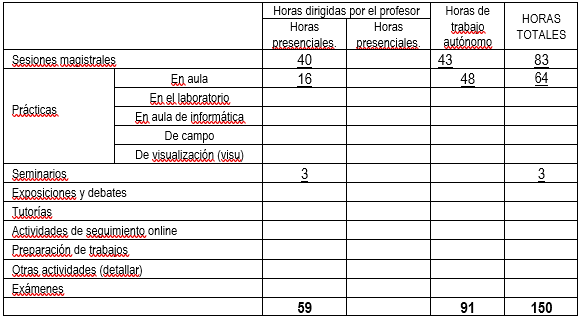
8. Anticipated distribution of the use of the different teaching methods
9. Resources
Reference books.
Alston, Philip and Mégret, Frédéric (eds.), The United Nations and Human Rights: A Critical Appraisal, 2nd ed., Oxford University Press, Oxford, 2020;
Bobbio, Norberto, The Age of Rights, Polity Press, Cambridge, 1996;
Janis, Mark W., Kay, Richard S. and Bradley, Anthony W., European Human Rights Law: Text and Materials, 3rd ed., Oxford University Press, Oxford, 2008;
Peers, Steve, Hervey, Tamara, Kenner, Jeff and Ward, Angela (eds.), The EU Charter of Fundamental Rights: A Commentary, 2nd ed., Hart Publishing, Oxford, 2021
C. Villán Durán y C. Faleh Pérez, "Manual de Derecho Internacional de los Derechos Humanos", 2016
Other bibliographic references, electronic or other types of resources.
Hathaway, James C., The Rights of Refugees under International Law, 2nd ed., Cambridge University Press, Cambridge, 2021
10. Assessment
Assessment criteria.
- Passing the exam (70%)
- Case-laws, participation and seminars (30%)
A minimum of 4.5 in the final test is required for all other criteria to be taken into account.
Evaluation systems.
|
Exam and seminars or case laws essays |
Assessment recommendations.
|
Keep the materials updated |
|
Recomendaciones para la recuperación. |
|
The final grade for the second examination period will correspond entirely to the mark obtained in the exam. |