


: THE PSYCHOLOGY OF EMOTIONS AND IDENTITIES IN GLOBAL POLITICS
Estudios Globales / Global Studies
Curso 2026/2027
1. Subject Information
(Date last modified: 29-05-26 10:56)- Code
- 140556
- Plan
- 405
- ECTS
- 3.00
- Type
- Opcional
- Year
- 4
- Duration
- Second semester
- Language
- ENGLISH
- Area
- CIENCIA POLÍTICA Y DE LA ADMINISTRACIÓN
- Departament
- Derecho Público General
- Virtual platform
Professor Information
- Profesor/a
- Emily Bickle Carty
- Group/s
- sin nombre
- Centre
- -
- Office
- -
- Office hours
- Martes 11:30-14:00
- Web address
- -
- Phone
- -
2. Association of the subject matter within the study plan
3. Prerequisites
No formal prerequisites are required. Students are expected to have a basic familiarity with political science concepts (at the level of introductory courses in the degree). Prior coursework in research methods is helpful but not mandatory. The course is conducted entirely in English; students should have a sufficient level of academic English to read scholarly articles and write analytical essays (B2 or higher recommended).
4. Learning objectives
1. Understand the core theories and concepts of political psychology and their application to global politics.
2. Analyze how emotions (fear, anger, disgust, hope) influence political attitudes, voting behavior, and foreign policy decisions.
3. Explain the formation and political consequences of social, national, and political identities.
4. Critically evaluate empirical research on political behavior using primary academic sources.
5. Apply political psychology frameworks to contemporary international events and case studies.
6. Develop argumentation and analytical writing skills in academic English.
7. Engage in evidence-based discussion and peer debate on contested political topics.
5. Contents
Theory.
BLOCK I: FOUNDATIONS OF POLITICAL PSYCHOLOGY.
Topic 1: Introduction to Political Psychology – history, scope, and key concepts.
Topic 2: Personality, authoritarianism, and political ideology.
Topic 3: Motivated reasoning, cognitive biases, and political judgment.
BLOCK II: EMOTIONS IN GLOBAL POLITICS.
Topic 4: Theories of emotion in politics – appraisal theory, affective intelligence theory.
Topic 5: Fear, threat perception, and foreign policy.
Topic 6: Anger, disgust, and populist politics.
Topic 7: Hope, enthusiasm, and political mobilization.
BLOCK III: IDENTITY AND INTERGROUP CONFLICT.
Topic 8: Social identity theory and self-categorization in international context.
Topic 9: National identity, patriotism, and nationalism.
Topic 10: In-group favoritism, out-group threat, and international conflict.
Topic 11: Affective polarization and democratic backsliding.
BLOCK IV: APPLICATIONS IN GLOBAL POLITICS.
Topic 12: Political psychology of leadership and foreign policy decision-making.
Topic 13: Media, framing, and political communication in global affairs.
Topic 14: Collective action, social movements, and transnational politics.
Topic 15: Reconciliation, trust-building, and post-conflict societies.
6. Competences acquired
Basic / General.
CB2, CB3, CB4, CB5 / CG1, CG2, CG4
Specific.
CE8, CE11, CE13, CE14, CE15, CE20
7. Teaching methods
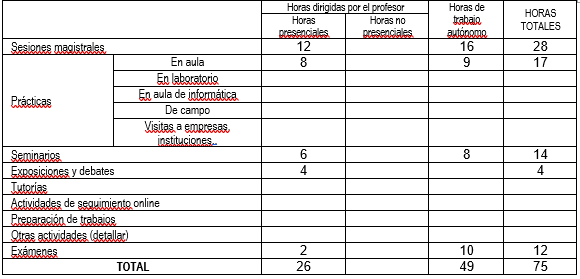
Lectures (sesiones magistrales): The professor introduces theoretical frameworks, key concepts, and empirical findings. Students are expected to complete assigned readings before each session.
Discussion seminars (prácticas en aula): Small-group discussion of assigned journal articles, case studies, and current events. Students are required to actively participate and engage critically with the readings.
8. Anticipated distribution of the use of the different teaching methods
9. Resources
Reference books.
Huddy, L., Sears, D. O., & Levy, J. S. (Eds.) (2013). Oxford Handbook of Political Psychology (2nd ed.). Oxford University Press.
Jost, J. T., & Sidanius, J. (Eds.) (2004). Political Psychology: Key Readings. Psychology Press.
Marcus, G. E. (2002). The Sentimental Citizen: Emotion in Democratic Politics. Penn State University Press.
Other bibliographic references, electronic or other types of resources.
Selected journal articles from: American Journal of Political Science, Political Psychology, Political Behavior, Journal of Conflict Resolution, and European Journal of Political Research (full reading list provided on Campus Virtual). Recommended journals: Political Psychology (Wiley); American Political Science Review. Documentary films and news excerpts may be used to illustrate course themes.
10. Assessment
Assessment criteria.
|
Consideraciones Generales |
|
Assessment is continuous and combines individual written work with active participation. All written assignments must be submitted in English. The use of AI-generated text without disclosure is considered academic misconduct. Attendance and active participation in seminars are required.
|
Participation and in-class reading checks (30%): quality of contributions to seminar discussion and performance on unannounced in-class reading checks completed at the start of sessions.
In-class article reflection presentation (30%): each student is assigned one week and delivers a critical oral review of that week’s assigned readings to the class, demonstrating comprehension, critical evaluation, and capacity to situate the readings within broader course themes.
Final exam (40%): in-class open-note exam covering key theories, concepts, and case studies from across the full course.
Evaluation systems.
Participation and in-class reading checks
In-class article reflection presentations
Final Exam (multiple choice, short-answer, and short essay)
Assessment recommendations.
|
Students are encouraged to complete all assigned readings before each session, as both the reading checks and the seminar participation grade depend on consistent preparation. Students assigned a presentation week should consult with the professor during tutoring hours in advance to discuss their approach. All in-class assessments are completed during scheduled class time; there are no take-home written assignments. |
|
Recomendaciones para la recuperación. |
|
Students who do not pass the continuous assessment may sit the official resit exam (convocatoria extraordinaria), which covers the full course content. In this case, the research essay may also be resubmitted with revisions. Students are strongly encouraged to meet with the professor during tutoring hours before the resit to identify specific areas for improvement. |