


VISUALIZING GLOBAL POLITICS
Estudios Globales / Global Studies
Curso 2026/2027
1. Subject Information
(Date last modified: 29-05-26 11:12)- Code
- 140558
- Plan
- 405
- ECTS
- 6.00
- Type
- Opcional
- Year
- 4
- Duration
- Second semester
- Language
- ENGLISH
- Area
- CIENCIA POLÍTICA Y DE LA ADMINISTRACIÓN
- Departament
- Derecho Público General
- Virtual platform
Professor Information
- Coordinador/a
- Iván Llamazares Valduvieco
- Group/s
- sin nombre
- Centre
- Fac. Derecho
- Office
- 156
- Office hours
- Appointment by email
- Web address
- -
- illamaz@usal.es
- Phone
- Extensión 1675
- Profesor/a
- Fátima María García Díez
- Group/s
- sin nombre
- Centre
- Fac. Derecho
- Office
- 211
- Office hours
- By email
- Web address
- http://campus.usal.es/~acpa/
- fatima@usal.es
- Phone
- 923294500 Ext. 1608 / 600583205 /Ext. 1675
- Profesor/a
- María Elena Martínez Barahona
- Group/s
- sin nombre
- Centre
- Fac. Derecho
- Office
- 163B
- Office hours
- Appointment by email
- Web address
- http://campus.usal.es/~acpa/
- embarahona@usal.es
- Phone
- 663088957 Ext.6960
- Profesor/a
- Carolina Plaza Colodro
- Group/s
- sin nombre
- Centre
- Fac. Derecho
- Office
- Oficina 1. Área de Ciencia Política. Planta Jardín
- Office hours
- Appointment by email
- Web address
- https://acpa-usal.com/member/dra-carolina-plaza-colodro/
- cplazaco@usal.es
- Phone
- Ext. 3510
- Professor
- Verónica Álvarez Núñez
- Group/s
- sin nombre
- Centre
- Fac. Derecho
- Office
- -
- Office hours
- -
- Web address
- -
- Phone
- -
- Profesor/a
- Eduardo Barreto Martín
- Group/s
- sin nombre
- Centre
- Fac. Derecho
- Office
- Planta Jardín
- Office hours
- Appointment by email
- Web address
- -
- eduardobarretomartin@usal.es
- Phone
- -
2. Association of the subject matter within the study plan
3. Prerequisites
|
Basic Political Science concepts. |
4. Learning objectives
This course explores how the main themes of global politics are represented and constructed through visual media, with a particular focus on film as a tool for critical political analysis. Students will develop analytical tools to "read" cinema as a political text, examining how films reflect, challenge, and shape political ideologies and collective memory.
5. Contents
Theory.
UNIT 1 — “The past is not dead, it is not even past”. Political violence, authoritarianism, and collective memories.
UNIT 2 — Images of Empire: From Imperialism to Decolonization
UNIT 2 — Raw cut: Present violence, drugs & crimes
UNIT 4 — Voice and noise. Elections, propaganda, and the struggle for democracy
UNIT 5 — From unions to algorithms. Challenges to collective action in the age of globalization.
UNIT 6 --- Cleavages: the influence of territory and class on social fracture
6. Competences acquired
Basic / General.
CB3, CB5, CG1, CG4
Specific.
CE4, CE13
7. Teaching methods
This course employs a variety of teaching methods designed to foster critical thinking and visual literacy. In addition to seminar discussions, Visualizing Politics makes extensive use of film screenings as a core pedagogical tool. Feature films, documentaries, and short films are used throughout the course to illustrate and critically examine how global politics are represented and constructed through visual media
⚠️ Warning: Some images in this course may be sensitive or disturbing to some viewers
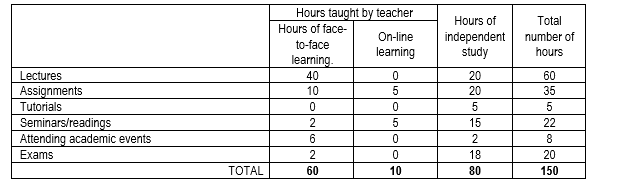
8. Anticipated distribution of the use of the different teaching methods
9. Resources
Reference books.
Alcántara Sáez, M. (2018). La política es de cine. Centro de Estudios Políticos y Constitucionales.
Alcántara, M., & Mariani, S. (Eds.). (2016). La política va al cine. Tecnos.
Caparrós Lera, J. M. (2017). 100 películas sobre historia contemporánea. Alianza Editorial.
Christensen, T., &; Haas, P. J. (2005). Projecting politics: Political messages in American films. Routledge.
Cousins, M. (2011). The story of film. Pavilion Books.
Gubern, R. (2016). Historia del cine. Anagrama.
Kilbourn, R. J. A. (2010). Cinema, memory, modernity: The representation of memory from the art film to transnational cinema. Routledge.
Lumet, S. (1995). Making movies. Knopf.
Smith, I. H. (2019). Cult filmmakers: 50 movie icons to discover. Laurence King Publishing.
Thomson, D. (2015). How to watch a movie. Alfred A. Knopf.
Other bibliographic references, electronic or other types of resources.
Reading material (available in Studium.)
10. Assessment
Assessment criteria.
|
General considerations |
|
The course will be assessed on a weekly basis through written assignments. Each assignment corresponds to the screening of a film scheduled for that week. Students are required to complete a minimum of 80% of the film screenings to fulfill the course requirements. |
|
Assessment criteria |
|
All late assignments will not be evaluated |
Assessment recommendations.
|
Practical exercises and quizzes (100% of the final grade): will evaluate your analytical and practical skills along the course. |
|
Guidelines in the case of failing the subject |
|
Final exam covering the course content (100% of the final grade) |