


Global Development Indicators
Estudios Globales / Global Studies
Curso 2026/2027
1. Subject Information
(Date last modified: 08-06-26 13:42)- Code
- 140549
- Plan
- 405
- ECTS
- 6.00
- Type
- Opcional
- Year
- 4
- Duration
- Second semester
- Language
- ENGLISH
- Area
- FUNDAMENTOS DEL ANÁLISIS ECONÓMICO
- Departament
- Economía e Historia Económica
- Virtual platform
Professor Information
- Coordinador/a
- José Antonio Ortega Osona
- Group/s
- Único
- Centre
- Fac. Economía y Empresa
- Office
- 234
- Office hours
- Contactar con el profesor
- Web address
- https://produccioncientifica.usal.es/investigadores/56478/detalle
- jaortega@usal.es
- Phone
- 923 294500 Ext 3172
2. Association of the subject matter within the study plan
3. Prerequisites
|
There are no formal prerequisites for this course. In terms of substance, it is related to other courses compulsory courses in the degree like “Methods and techniques”, “International Relations”, “Poverty and Inequality”, “Development Policy” or “International Organizations”. A background in basic statistics is useful, as well as knowledge of the international development agenda and the SDGs. No prior knowledge of computing is required, but previous experience with Excel, R and AI (Gemini, NotebookLM) is useful. |
4. Learning objectives
This is a hand-on course on monitoring progress towards development goals with a global perspective. We will review the theory behind development indicators and the current development framework, including the process of setting up goals and a monitoring framework. Attention will focus on the current Sustainable Development Goals and composite development indicators such as the Human Development Index.
Practical work will be based on monitoring development goals using R. We learn how to obtain official data for development indicators from sources like the UN, the World Bank or Eurostat, how to process the data and put it into use, producing documents that combine analysis, graphs and tables to communicate on progress towards development goals.
The objectives of the course are, in particular:
- Learn how a development framework such as the SDGs is adopted, and the role of indicators in global monitoring.
- Learn efficient techniques to gather, manage and analyse global development data including the joint use of AI and R.
- Learn how to make a good analysis of development trends based on international data, using a sound methodology for a relevant purpose.
Relate global development goals to applied development practice, either at the global, regional, National or sub-National level.
5. Contents
Theory.
The course is based on a dual structure: practice sessions in the Computer Lab on Mondays, and lectures / group discussions on Tuesdays. These are the contents for the two types of sessions:
Theory:
- The SDG framework as an evolution of statistical monitoring for development purposes.
- What is behind the SDG framework: Technical Group setting indicators and carrying out official monitoring.
- Theory of indicators and theories of change. Good indicators. Composite indicators.
- The Human Development Index as a composite indicators: Philosophical and practical issues.
- Ethical uses of AI and LLM and their use for development monitoring
- Data sources for indicators: A. Household surveys, B. Administrative data, C. Policy indicators
- Monitoring policies: Analyzing and describing data availability, levels, trends, and inequality.
- Indicators for special topics: Demographic and Health, Economic, Environmental, Education.
- The relevance of the SDGs and policy impact of the SDG framework.
Practice:
- Introduction to R and RStudio.
- Working with data objects (tidyverse)
- Plots and maps.
- Merging different data
- Generating good quality html reports: Markdown and Quarto documents
- IA assistance in writing code, performing analysis and improving presentation (Gemini and NotebookML).
Work on the specific projects
6. Competences acquired
Basic / General.
C3. Conocer las organizaciones internacionales, sus funciones y estructura, así como los procesos de integración y en especial la Unión Europea.
C11. Conocer los retos y amenazas globales a la estabilidad los sistemas económicos, políticos y sociales nacionales, regionales y mundiales.
C12. Conocer los retos y amenazas globales que ponen en riesgo la paz y la seguridad, los derechos humanos y la justicia, el medio ambiente y la producción sostenible o la igualdad, entre otros.
C13. Identificar y describir las causas y la evolución de las situaciones de pobreza y desigualdad en el mundo.
C16. Conocer distintas técnicas de análisis estadístico y de contenido, preparación y representación de datos económicos, políticos y/o sociales de carácter micro, meso o macro y ámbito global.
C17. Conocer la organización y componentes de un proyecto de análisis de situación, resolución de conflictos y/o reforma pública con implicaciones internacionales o globales, así como las estrategias de comunicación en formato escrito, oral y visual.
Specific.
H1. Obtener nuevas fuentes de información y explotación de fuentes de información existentes.
H2. Procesar, interpretar, describir y hacer uso de información numérica categórica, ordinal o de intervalo y los conceptos científicos asociados a ella.
H4. Operar con las herramientas de software y tecnológicas más utilizadas tanto en el análisis cuantitativo como cualitativo.
H5. Comparar unidades de análisis de distinto tipo con rigor científico.
H6. Manejo programas estadísticos para el análisis descriptivo, correlacional y causal de big data y minería de datos globales.
H7. Elaborar informes, proyectos y estrategias de actuación globales multidisciplinares
H10. Aprendizaje continuado de manera autónoma en las materias objeto de estudio.
H11. Trabajar en equipo, con responsabilidad e inquietud para la aplicación práctica de los conocimientos adquiridos en diferentes roles.
H12. Resolver trabajos con límites temporales y de recursos.
H13. Sintetizar evidencias para la argumentación y comunicación oral y escrita
H22. Pensamiento creativo para la generación de propuestas de política pública en materia de medio ambiente, salud pública, desarrollo, pobreza y desigualdad.
Transversal.
K.1 Aplicar pensamiento estratégico, identificando metas y diseñando planes de acción multidimensionales para alcanzarlas.
K.2 Planificación, evaluación y control de distintas soluciones de utilidad para la elaboración de políticas públicas.
K.3 Determinar y conectar la información necesaria y/o disponible con fines y misiones contenidos en proyectos de resolución de problemas públicos globales.
K10. Recopilar datos de distintas fuentes y áreas de especialización que permitan la aplicación del método científico de investigación a problemas de índole o trascendencia global.
K11. Realizar análisis mediante distintos tipos de técnicas o con diseños integrados para testar hipótesis y/o identificar los determinantes del tema, aspecto o problema que se quiere abordar.
K13. Representar datos, hechos o análisis de origen económico, político, social o jurídico de ámbito global de forma sintética, visualmente atractiva y fácilmente interpretable.
K15. Transmitir información, ideas, y soluciones a un público tanto especializado como no especializado.
7. Teaching methods
Diverse methodologies are applied to ensure progress on the theoretical and practice aspects.
- In-class lectures in theory sessions.
- Presentation by students of the nature of the specific characteristics of the data they use.
- Examples of analysis using R provided in Studium.
- Practice sessions in the computer room including the use of R, the use of AI (Gemini, NotebookLM), and the joint use of both.
- Moodle questionnaires and quizzes.
A team project (in couples) on a specific example of development monitoring, supervised by the professor, leading to an html document published on the web and presented to the rest of the class
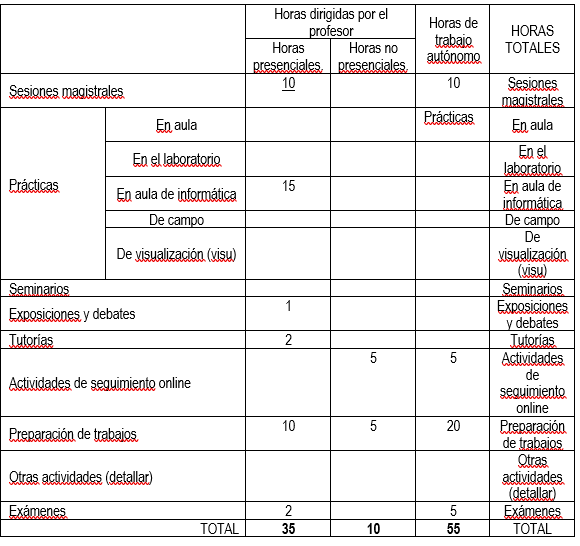
8. Anticipated distribution of the use of the different teaching methods
9. Resources
Reference books.
Ortega, J. A. (2023) Monitoring global indicators with R and the tidyverse, Rpubs.com. https://rpubs.com/jaortega/tidyverse-goalie-2023 https://rpubs.com/jaortega/tidyverseWB2023
Ritchie, Roser, Mispy, Ortiz-Ospina (2023), Measuring progress towards the Sustainable Development Goals.SDG-Tracker.org, website.
Hadley Wickham, Mine Çetinkaya-Rundel, Garrett Grolemund (2023) R for Data Science, 2nd Ed., O’Reilly. https://r4ds.hadley.nz/
Healy, Kieran (2026) Data visualization: A practical introduction. 2nd. Ed., Princeton University Press, https://socviz.co/
UN (2026) Sustainable Development Goal indicators website, https://unstats.un.org/sdgs/, website
Other bibliographic references, electronic or other types of resources.
Sachs, J., Lafortune, G., Kroll, C., Fuller, G., Woelm, F. (2022). From Crisis to Sustainable Development: the SDGs as Roadmap to 2030 and Beyond. Sustainable Development Report 2022. Cambridge: Cambridge University Press.. https://sdgindex.org/reports/sustainable-development-report-2022/
UN (2020), Global indicator framework for the Sustainable Development Goals and targets of the 2030 Agenda for Sustainable Development, UN, New York, https://unstats.un.org/sdgs/indicathttps://unstats.un.org/sdgs/indicators/indicators-list/ors/indicators-list/
UN (2026), The Sustainable Development Goals Report 2026, UN, New York https://unstats.un.org/sdgs/report/2026/
UNSDSN (2015), Indicators and a monitoring framework for the sustainable development goals: Launching a data revolution for the SDGs. Sustainable Development Solutions Network, Av https://resources.unsdsn.org/indicators-and-a-monitoring-framework-for-sustainable-development-goals-launching-a-data-revolution-for-the-sdgs
Software
R (https://www.R-project.org/), RStudio (https://rstudio.com/) and specific packages (tidyverse, goalie, WBstats). Gemini and NotebookLM.
Other references: Specific references and materials will be provided in Studium.
10. Assessment
Assessment criteria.
|
Consideraciones Generales |
|
Evaluation is based on demonstration that the specific objectives have been achieved in terms of learning objectives. Specific evaluation tools include individual moodle quizzes, in-class participation and presentation on data source, the final document produced in the team project and its presentation. |
|
Criterios de evaluación |
|
Evaluation systems.
Evaluation will be based on continuous evaluation and the final project. There will be no exam, unless voluntarily taken to have a change of improving the grade.
Quizzes and class activities: 40% of the final grade
In-class participation: 20% of the final grade
Final project: 40% of the final grade
Assessment recommendations.
|
Recomendaciones para la evaluación. |
|
To excel in the course it is important to combine the theoretical background, being able to relate the analysis of indicators to specific development goals, and to circumvent the practical challenges in working with data and carrying out a relevant analysis. While we will use AI to improve our coding and analytical skills, it is important to learn the basic techniques first. Otherwise you will not be able to judge if the IA is doing as intended, or to guide it for your specific purposes.
|
|
Recomendaciones para la recuperación. |
|
Identification of the specific reasons for unsatisfactory performance and specific work to circumvent it. |