


GLOBAL TRADE LAW
Estudios Globales / Global Studies
Curso 2026/2027
1. Subject Information
(Date last modified: 15-06-26 9:58)- Code
- 140529
- Plan
- 405
- ECTS
- 6.00
- Type
- Compulsory
- Year
- 4
- Duration
- First semester
- Language
- ENGLISH
- Area
- DERECHO MERCANTIL
- Departament
- Derecho Privado
- Virtual platform
Professor Information
- Coordinador/a
- Andrés Trujillo Jiménez
- Group/s
- Único
- Centre
- Fac. Derecho
- Office
- 216
- Office hours
- Upon request by email
- Web address
- http://www.usal.es/webusal/
- andtruji@usal.es
- Phone
- 923 294441 – 923 294445 Ext. 1635
2. Association of the subject matter within the study plan
3. Prerequisites
No previous requirements are needed
4. Learning objectives
Global Trade Law aims to provide students with a solid understanding of the institutions, instruments, and legal frameworks governing international trade, with particular focus on the WTO system, regional agreements, and bilateral investment treaties. Students will develop analytical skills to interpret trade law provisions, assess dispute settlement rulings, and evaluate the interaction between trade rules and broader policy areas such as environmental protection, human rights, and development. Finally, the subject fosters critical and interdisciplinary thinking, enabling students to engage with contemporary debates on global trade governance and to apply their knowledge effectively in professional and academic contexts
5. Contents
Theory.
Part 1. Global Commercial and Trade Law
- Module 1. Foundations of Global Trade Law
- Module 2. The WTO: Institutional Architecture/Core Principles: MFN and National Treatment
- Module 3. Trade in Services, Digital Trade, and Intellectual Property
- Module 4. Regional Trade Agreements and Global Supply Chains
- Module 5. Trade, Sustainability, and Economic Security
Part 2. Global Competition Law
- Module 6. Foundations of Global Competition Law
- Module 7. Anticompetitive Agreements: Article 101 TFEU, Abuse of Dominance, and Merger Control
- Module 8. Competition Law in Digital and Global Markets
- Module 9. Competition, Sustainability, and Industrial Policy
Module 10. Corporate law
6. Competences acquired
Basic / General.
CB1. CB2. CB3. CB4. CB5. CG2. CG4
Specific.
CE3. CE4. CE7. CE10. CE12. CE13. CE19.
7. Teaching methods
- The proposed competencies will be achieved through various teaching methodologies:
- INTRODUCTORY ACTIVITIES: To establish contact with students, present the course, and provide information about the development of teaching and assessment.
- THEORETICAL CLASSES: Lectures or master classes explaining the course content.
- MATERIALS ON STUDIUM: Sections of some of the topics covered in the syllabus, along with various materials (regulations, rulings, articles, etc.), will be made available on the Studium platform.
- PRACTICAL ACTIVITIES: Analysis, resolution, and discussion of case studies related to the subjects being explained. A case study will be presented in which students must propose solutions.
- PRACTICAL CLASSES: Practical exercises will be solved in class under guidance, with active student participation and moderated debate.
- SEMINAR, PRESENTATION, DEBATE: Occasionally, and depending on course development: Seminar(s) (to delve deeper into certain topics or expand on lecture content), Presentation (on a proposed issue or topic), Debate(s) (in-person or in the forum, on current issues, individually or in groups). All within class hours.
- TUTORING SESSIONS: Assistance, guidance, and resolution of students' questions, either individually or in groups.
8. Anticipated distribution of the use of the different teaching methods
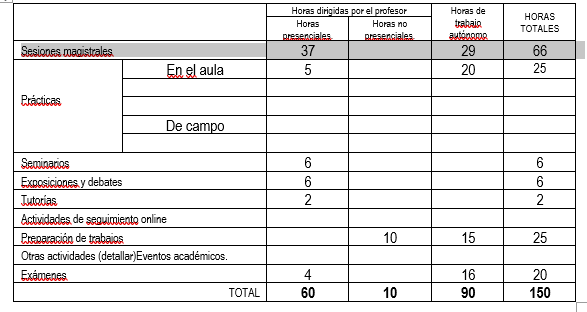
9. Resources
Reference books.
- MISHRA, N., 2024. International Trade Law and Global Data Governance : Aligning Perspectives and Practices. Oxford: Bloomsbury Academic. ISBN 1-5099-6170-4.
- CHENG, J., 2022. A new global economic order : new challenges to international trade law. Leiden, The Netherlands ; Brill Nijhoff. ISBN 9789004470354.
- MATSUSHITA, M. y SCHOENBAUM, T.J., 2016. Emerging Issues in Sustainable Development : International Trade Law and Policy Relating to Natural Resources, Energy, and the Environment. 1st ed. 2016. Tokyo: Springer Japan. ISBN 4-431-56424-1.
- WHISH, R. y BAILEY, D., 2012. Competition law. 7th ed. Oxford ; Oxford University Press. ISBN 978-0-19-958655-4.
- WIJCKMANS, F. y TUYTSCHAEVER, F., 2011. Vertical agreements in EU competition law. 2nd ed. Oxford ; Oxford University Press. ISBN 978-0-19-969641-3.
- COTTIER, T. y MAVROIDIS, P.C., 2003. Intellectual property: trade, competition, and sustainable development. Ann Arbor, Mich: University of Michigan Press. vol. 3. ISBN 0472112058.
- Brown, A. E., & Waelde, C. (Eds.). (2018). Research Handbook on Intellectual Property and Creative Industries. Cheltenham, UK: Edward Elgar Publishing. Retrieved May 18, 2026, from https://doi.org/10.4337/9781786431172
Other bibliographic references, electronic or other types of resources.
- https://www.wto.org/index.htm
- https://www.wipo.int/portal/en/index.html
- https://www.euipo.europa.eu/en
https://www.usitc.gov/
10. Assessment
Assessment criteria.
|
Consideraciones Generales |
|
The course's assessment is based on continuous monitoring of students’ learning, work, and engagement.
|
|
Criterios de evaluación |
|
Evaluation systems.
Continuous assessment: discussion forums, presentations, case studies, etc. = 40%
Final exam = 60%
Assessment recommendations.
|
Recomendaciones para la evaluación. |
|
Attendance to class, completion of exercises, and reading of the recommended and required texts for each topic are strongly recommended. |
|
Recomendaciones para la recuperación. |
|
No variations |