


International Consumer Protection
Estudios Globales / Global Studies
Curso 2026/2027
1. Subject Information
(Date last modified: 15-06-26 11:02)- Code
- 140554
- Plan
- 405
- ECTS
- 3.00
- Type
- Opcional
- Year
- 4
- Duration
- Second semester
- Language
- ENGLISH
- Area
- DERECHO CIVIL
- Departament
- Derecho Privado
- Virtual platform
Professor Information
- Profesor/a
- Felisa María Corvo López
- Group/s
- Único
- Centre
- Fac. Derecho
- Office
- 114
- Office hours
- To be agreed with the student
- Web address
- https://produccioncientifica.usal.es/investigadores/57425/detalle
- marcorvo@usal.es
- Phone
- 923294441 - Ext. 1663
2. Association of the subject matter within the study plan
3. Prerequisites
There are no specific or extra requirements to take this course.
4. Learning objectives
The course does not aim to provide an exhaustive overview of consumer protection legislation worldwide, but rather to cover the main features of the consumer protection system in the contractual sphere, particularly within the European Union. Some of the readings include more technical components, but it does not presuppose any extra requirements for taking the course.
5. Contents
Theory.
- International Law and Consumer Protection
- European Union measures to protect consumers
- Concept of the consumer
- General rules governing consumer contracts
- General terms and conditions and unfair terms
- Distance contracts and off-premises contracts
- The purchase of consumer goods and the provision of digital content and services
- Sustainable consumption
- Consumer credit and mortgage loans
- Package holidays
- Product safety and liability for damage caused by defective products and services
- Liability for damage caused by artificial intelligence
- Complaints
6. Competences acquired
Basic / General.
Students are expected to enrol into an active learning process. They will be able to analyse and apply different perspectives about the main debates on the field of International consumer protection from a critical reasoning. They will be able to build strong arguments within the discipline (CB2). Also, students will be qualified to understand and interpret relevant data to elaborate insightful judgments within the field of International consumer protection (CB3), to convey information, ideas, problems and solutions to both specialist and non-specialist audiences (CB4) and to solve specific problems in larger and multi-disciplinary contexts (CG1). Finally, the acquisition of these skills will be relevant and necessary for those students interested in advancing their careers and pursuing postgraduate studies (CB5).
Specific.
More specifically, students will be able to recognize historical elements of social and political processes (CE2) and understand the structure and functioning of the European Union (CE4).
7. Teaching methods
Lectures, case studies, discussions, poster presentations
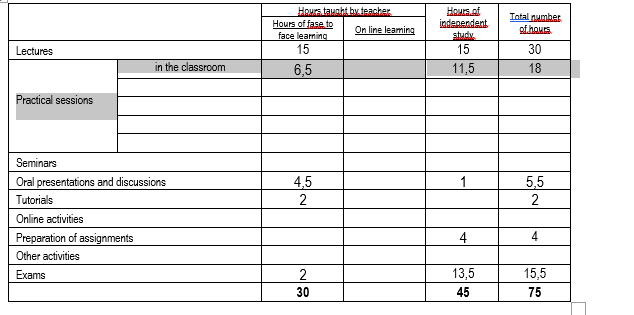
8. Anticipated distribution of the use of the different teaching methods
9. Resources
Reference books.
Avilés García, J. Hacia un consumo sostenible: Compraventas de bienes, suministros digitales y nuevas medidas legales, Tirant lo Blanch, 2025
- Bech Serrat, J. M. Selling tourism services at a distance: an Analysis of the EU Consumer Acquis, Springer USA, 2012
- Santaolalla Montoya, C. (Coord.) Consumer protection in the European Union: Challenges and opportunities. Publications Office of the European Union, 2023.
Other bibliographic references, electronic or other types of resources.
Legislation
Case law
Websites, such as:
Recommended reading, such as:
- Berenguer Albaladejo, C. “Luces y sombras de la nueva Directiva (UE) 2015/2302 del parlamento europeo y del consejo, de 25 de noviembre de 2015, relativa a los viajes combinados y a los servicios de viaje vinculados”, International journal of scientific management and tourism, Vol. 2, Nº. 2, 2016, pp. 33-49.
- Busch, C., Jull Sørensen, M., Rodriguez de las Heras Ballell, T. and Twigg-Flesner, C. Towards the Next Generation of Consumer Law: the ELI Guiding Principles and Model Rules on Digital Assistants for Consumer Contracts, Volume 14, Issue 3 (2025) pp 89-132, CH Beck, 20 June 2025.
- González Castillo, J. Products liability in Europe and the United States*: responsabilidad por productos defectuosos en Europa y Estados Unidos, Revista chilena de derecho, Vol. 39, Nº. 2, 2012, pp. 277-296.
- Kenna, P. Simón Moreno, H. Towards a common standard of protection of the right to housing in Europe through the charter of fundamental rights, European Law Journal, , Vol. 25, Nº. 6, 2019, pp. 608-622.
- Leveneur-Azémar, M. Directive (UE) 2023/2225 relative aux contrats de crédit aux consommateurs du 18 octobre 2023: quelques précisions, pas de révolution, Revue des affaires europeennes, Nº 1, 2024, págs. 85-96.
- Martín-Casals, M. An approach to some EU initiatives on the regulation of liability for damage caused by ai-systems, Ius et Praxis, Vol. 28, Nº. 2, 2022, pp. 3-24.
- Martín Pérez, J. A La nueva regulación europea de los contratos de crédito al consumo: claves de la Directiva (UE) 2023/2225 y el reto del crédito responsable, Cuadernos de derecho transnacional, Vol. 17, Nº. 2, 2025, pp. 476-501.
10. Assessment
Assessment criteria.
|
Consideraciones Generales |
|
All students are expected to keep up with the required readings and to attend classes. |
|
Criterios de evaluación |
|
Students will be assessed according to the following criteria:
|
Evaluation systems.
|
|
Assessment recommendations.
|
Students are highly encouraged to attend the classes, engage with the preparatory material (readings), prepare the assignments on time, as well as actively participate in the discussions. All late assignments will not be evaluated. If you do not upload your exercises, quizzes and research report before the due date you will not have another opportunity. Academic dishonesty will not be allowed. |
|
Recomendaciones para la recuperación. |
|
You will have two opportunities to sit the final exam, but you will not be able to resit the other course assignments. The final mark for the second sitting will be weighted in the same way as for the first. |