Curricular area to which the subject matter pertains.
Purpose of the subject within the curricular area and study plan.
Negotiation in specific contexts is a basic activity of the firm..
Professional profile.
LEARNING OUTCOMES
The main objective of this course is to train the student in the basic concepts on Negotiation in Specific Contexts.
Specifically, the student will know the basic concepts, theoretical foundations, main practices, skills and design instruments and will be able to replicate negotiation processes in different business contexts, including the international one.
Theory.
BRIEF DESCRIPTION OF CONTENTS
UNIT 1. INTRODUCTION TO NEGOTIATION AND CONFLICT MANAGEMENT
UNIT 2. DEFINITION, CHARACTERISTICS AND TYPES OF CONFLICT AND NEGOTIATION
UNIT 3. THE NEGOTIATING PHASES
UNIT 4. THE NEGOTIATING PROCESS
UNIT 5. INTERNATIONAL NEGOTIATION
UNIT 6. A METHOD FOR NEGOTIATING AND MANAGE CONFLICTS
UNIT 7. PSYCHOLOGY OF THE NEGOTIATING PERSON
UNIT 8. NEGOTIATING STRATEGIES AND TACTICS.
UNIT 9. NEGOTIATING CONTEXTS
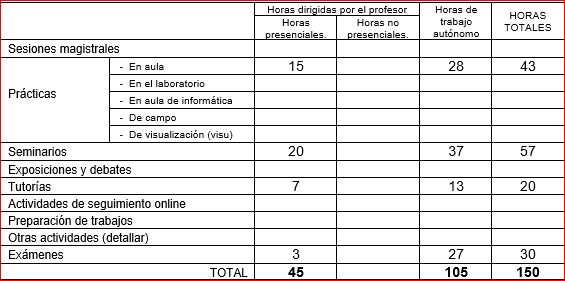
- Theoretical / lecture / lecture sessions, necessary for the presentation of the theoretical content and basic foundations of the subject.
- Practical sessions, necessary to apply the acquired theoretical knowledge to business reality. They will be developed in the classroom, in the form of:
• Discussion and resolution of practical questions.
• Sharing of practical cases.
• Debates on applied reading and economic press news.
• Reflection on practical aspects through videos.
• Seminars.
• Presentation and defense of papers and exercises.
• Putting into direct action through group dynamics.
- Tutoring sessions, face-to-face and online, necessary to carry out a more personalized follow-up of the student and guide her/him.
- Student work linked to the theoretical, practical and tutoring sessions, of a non-face-to-face nature. It will develop in the form of:
• Reading of documents.
• Search and reading of complementary documentation.
• Carrying out individual and group work.
• Resolution of practical cases.
General considerations.
The subject follows a continuous assessment system where the most important assessment of the student takes place in the activities carried out throughout the semester. Continuous assessment accounts for 40% of the grade.
There will be a test / exam at the end of the course of a global nature that will account for 60% of the total grade. It will be necessary to achieve 50% in the continuous evaluation to be able to take the final test / exam.
Assessment criteria.
Active participation in class, in the discussion and resolution of practical questions, in the sharing of practical cases, in the analysis and resolution of quantitative problems, in the debates on applied reading and economic press news, in the reflection on the projected videos, in the seminars for the application of contents, in the presentation and defense of works and exercises, and in the direct action carried out in group dynamics and in the objective final test.
Assessment tools.
The continuous assessment will consist of:
•Practical cases
• Classroom discussions
•Group dynamics
Assessment recommendations.
Carry out continuous work, participating in all scheduled theoretical and practical activities, through daily work by the student.