Curricular area to which the subject matter pertains.
Purpose of the subject within the curricular area and study plan.
The course on Economics of Global South focuses on the study of economic development in the Global South from a long-term perspective. This course complements the knowledge acquired by the students in the courses on International Political Economy, Development Politics and Poverty and Inequality. It offers to students the possibility of deepening their knowledge about key sectors of the global economy in which the countries of the Global South play a key role.
Professional profile.
Public sector, private sector, research, international cooperation, consulting, academia, and public policy development and analysis, among others.
Theory.
Part 1: Introduction
1. Doughnut Economics
2. Circular Economy
Part 2: The Global South
3. Countries and Regions of the Global South
4. South-South Cooperation and Economic Integration
5. International value chains in the Global South
Part 3: Key Economic Sectors
6. Natural resources and extractive industries
7. Food and Agriculture
8. Technology and Telecommunications
9. Textile and clothing industries
10. Trade and Infrastructure
11. Tourism
Practice.
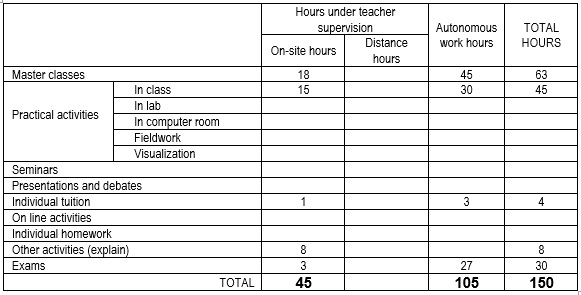
The course on Economics of Global South includes a combination of three different practical activities:
- Seminars: Students will analyze suggested texts and undertake writing activities every week. Students will have to present written essays with their own thoughts and conclusions through Studium and participate in class discussion and debates.
- Readings: A set of books are recommended. Students have to read at least one of the books and write a short essay answering a set of questions provided by the teacher. A debate will be organized in class.
- Active learning activity: A simulation or another active learning activity will be organized to allow students to better understand the status of poverty and inequality conditions in the World.
Basic / General.
BS1. Students must demonstrate to understand and manage specific knowledge for this area of study, based on general higher education. This knowledge is commonly based on advanced text books, but may also include some aspects belonging to the forefront of its area of study.
BS2. Students must demonstrate to know how to apply the acquired knowledge to their professional career or to their vocation in a professional way, and to have all required competencies that are usually demonstrated by building and defending arguments, and by solving problems within the area of study.
BS3. Students must show ability to gather and interpret relevant data, usually from their area of study, to make judgements based on a reflection on relevant topics from a social, scientific and ethical perspective.
BS4. Students must be able to transmit information, ideas, problems and solutions to a specialized and non-specialized audience.
Specific.
GS1. To apply the acquired knowledge to solve specific problems in new or unknown environments, within a wider (or multidisciplinary) contexts.
GS2. To know and apply several research methods in the area of social sciences with the purpose of analyzing problems linked to their area of expertise.
GS3. To develop organizational skills, task planning and project coordination, in order to foster teamwork.
GS4. To develop a set of skills to design and implement plans and problem-solving programs, from a global and multidisciplinary perspective.
Transversal.
SS2. To understand the historical dimension of political and social processes at the international level.
SS3. To understand the structure and functioning of the different international organizations and/or integration processes.
SS6. To evaluate and analyze the different guidelines of States’ foreign policy.
SS9. To know and understand the basic notions of Political Economy, and its financial and commercial dimensions.
SS10. To identify and describe poverty and inequality situations. Identify causal factors and analyze the evolution and achievements of different cases.
SS13. To identify and understand the different decision-making and problem-solving mechanisms within he international context.
SS20. To analyze and understand the political scenario from a global perspective, being able to differentiate among several sources of power legitimacy for stakeholders and institutions, and other basic State’s components and the institutional design of political systems.
General considerations.
Students must demonstrate a sufficient level of the required general, basic and specific skills to pass the course.
Assessment criteria.
The evaluation includes theory and practice, and it is structured in two different parts: continuous evaluation and a final exam. Continuous work and the final exam represent 50 % and 50 % of the final grade, respectively. It is mandatory to successfully perform on both parts of the evaluation to pass the course (At least 25% of the grade on each).
Assessment tools.
Continuous evaluation (50 % of the final grade):
Seminars (Weekly practical activities): 20 % of the final grade.
Reading: 10 % of the final grade.
Simulation or another active learning activity: 20 % of the final grade.
Final exam (50% of the final grade):
The final exam includes theoretical and practical knowledge acquired over the course. It will be based on the concepts studied in the master classes and the weekly seminars.
Assessment recommendations.
Constant work during the different activities in which the continuous evaluations is divided. Active participation in theoretical classes and seminars.
Guidelines in the case of failing the subject.
Constant work during the different activities in which the continuous evaluations is divided. Active participation in theoretical master classes and seminars.